Friday, June 14, 2019

Urban Air Mobility

It is further away than most people will tell you. 

Everyone sees the electric quad-copters, like DJI and such, and wishes they could ride on one. It seems so simple, just scale it up, and it can carry you, and a friend. Easy enough to fly, it will be fantastic, they go fast, no congestion in the sky, life is good. Lets do it!


Wow, there is a lotta money being spent on these vehicles, and not just from dreamers and hobbyists, but real live aerospace companies. Bell, Airbus and Boeing are all looking at the space, and at least throwing out drawings of stuff that might work. To be honest, you'd be silly to not be looking at this space, just in case.

What few people are saying, though, these little multi-copters that do vertical take-off and landing are not going to be main stream. If you can't afford to fly around in a helicopter today, you will not be able to fly in one of the passenger carrying multi-copters either. The cost will be similar when all is said and done, to flying in a modern helicopter.

Right now the batteries are the limiting factor. Even with a DJI or other "drone" type multi-copter it takes at least twice as long to charge the battery as the flight was. A 15 minute flight will take about 30-45 minutes to charge the battery for the next 15 minute flight. If you are Uber or some other air taxi service, this will kill the economic model right away. Every vehicle will spend over 2/3 of it's time charging between flights. Swapping battery packs may be an option, since the operator can have multiple packs charging at each station, but that will preclude landing in your neighborhood.

The multi-copters are noisy! People complain about jet noise around airports, so they don't live near any. Imagine you neighbor flying to work at 5:30AM everyday in one of these multi-copters. You will be up at 5:30AM yourself, and might as well go to work, you are up anyway. Having dozens of these flying over a venue you are at will certainly be annoying, plus think of the congestion that may occur for concerts and sporting events. Yup, it will be like the roads, with vehicles flying in to pick up passengers, blocking the vehicles with passengers trying to leave. With 3 or 4 pads near a arena will certainly be a limitation.

There is talk about putting pads on top of buildings, or at least high up. Winds are usually stronger higher up. Near the ground you might only have a 10kt wind, but up 20 stories (200ft) the winds may be 30-40kts. There will be turbulence for sure, but imagine the up and down drafts around buildings, and each landing and takeoff will be quite treacherous. Bad weather will be a whole other challenge, with heavy snow or ice storms, these vehicles won't be flying at all.

The multi-copters have multiple single points of failure. If a single motor fails on a quad-copter, the vehicle is coming down, the other three motors will not keep the craft flying. A hex or octa-copter will survive a single engine failure, but will probably not be able to complete the mission. Motors are electro-mechanical devices, they fail in different ways (bad bearings, broken wires, etc). Electronics fail, sensors fail, batteries fail. There is only so much redundancy that can be added to the vehicle to make it safe enough.

(Helicopters have many single points of failure as well, but there are usually ways to at least get the aircraft on the ground safely when any of them fail. An example is fuel exhaustion, when the motor(s) quit, the rotors can store energy. The pilot can pitch the craft down, such that the rotor is collecting energy from the movement through the air, that just before touching down, the aircraft can use that energy to slow the craft down and land soft enough-autorotation).

The propellers on the multi-copters are typically fixed pitch light weight affairs. Being fixed pitch means they are optimized for one realm of flight, typically for creating lift (forward motion, is more lift in the rear propellers, than the front ones). Should an engine fail, they have no mass to store energy, and will probably spin the wrong way in descent to be used for autorotation. Being light weight, they can be damaged easily by foreign objects, including birds, rocks, hail, trees, and people.

Commercial certification

Five years is very optimistic certification timelines people are pushing today for these urban air vehicles. If people where flying in these vehicles everyday, even experimentally, I could see maybe something could get pushed through in 5 years. As things are, maybe there is a Chinese company that is occasionally flying with people semi-regularly.

The FAA, EASA and the other regulating bodies will not let one of these vehicles get certified until it has proven capable through rigorous testing. That includes off normal operations, high winds, poor weather, and broken systems. It will take years of testing to get one of these vehicles certified to carry paying passengers.

Plan B


As a pilot you are always taught to look ahead, and consider your options. If an engine fails, where will I go, if a bird crashed through the windshield what will I do. If another aircraft is near me how do I avoid it, etc. The multi-copter pilot or automation will need to consider all of these things as well.

The vertical takeoff/vertical landing craft will need a plan B for the vertical part. While the vehicle is between 20 and 75 feet off the ground, no parachute system will save the occupants. If the vehicle has a failure, and it is coming straight down, the people in the vehicle will get hurt. I think even 75ft is optimistic, and more likely 200 feet or more will be needed to operate a parachute to save the occupants from injury. Parachute fail occasionally, that is why skydivers carry 2, and a spare chute won't save a crashing vehicle below 200ft.

In horizontal flight, if a propeller is damaged or an engine is down on power, the vehicle will need to land soon. Is there a safe place to put down over an urban area? The planning needs to be done before the flight, or for sure before the event occurs. Weather changes sometimes quickly, can the vehicle handle the unforcast weather properly? The hybrid winged vehicles are better in some respects. They can usually glide in an engine failure situation, but is there a suitable place to land near where this happens?


We need to let the smart people look at this carefully, so that we don't hurt folks.


Wednesday, March 23, 2016

The A4A won't give up

I sorta promised, I would go on about my last post. I guess I didn't think it would take a month and a half. I thought either the AIRR bill would get jammed through and there would be no stopping it, or it would go away. It almost went away, it was put on a shelf.

Representative Shuster has left a hole in the budget for a private ATC. Of course Mr Shuster is a little too friendly with the whole A4A crowd. He ought to recuse himself from this discussion. Follow the money they say, well Mr Shuster gets quite a bit of money from the A4A. Draw your own conclusions about weather this gentleman is representing his constituents or not.

So there is an argument, as there always is when congress wants to change the FAA, we are still using "WWII technology called RADAR". Oh my, that antiquated RADAR technology is going to make the aircraft fall out of the sky. Modernization isn't happening as fast a someone wants it to. Satellite based separation is the future and we need it now.

The sad thing is, the FAA's ATC system supports satellite based navigation. The ERAM program added it long ago. ADS-B was part of CARTS that was replaced by STARS/TAMR which had ADS-B 15 years ago. The fact is, the airlines are whining that it will cost them too much to equip older aircraft with ADS-B by 2020. The US Air Force is also complaining that they don't have the budget to make the 2020 ADS-B deadline. The trouble isn't the FAA, the trouble is the users can modernize quick enough.

I guess it makes sense. If they add another bureaucracy to keep the process inefficient, then there will be someone else to blame when they don't make the deadline. The A4A and the airlines seem to be arguing the private ATC corporation will be better, faster and cheaper. NASA learned that lesson a long time ago, better, faster cheaper can't happen. In this case, Faster will be hung up in committees and interfaces. Better will be hung up with new management wanting to change and current employees explaining why the new way won't work. Cheaper, well, government right.

The Shuster/A4A bill will create this fancy corporation. There will be a board to make the critical decisions. Critical decisions will be things like what products should be funded. Since the board will be mostly airline appointments, the choices will generally benefit the airlines more than anyone else. Imaging a 9/11 type situation, where all the flights are ground stopped. Who will pay the corporation for the week the aircraft didn't fly? It'll take a government bailout probably, or the corporation will veto national security, and require the airlines fly their normal schedule.

The Senate FAA Reauthorization Act of 2016 (S. 2658) is welcomed by many of the aviation groups. I think they will take anything but the AIRR act. There are plenty of things wrong with this bill as well. It may go too far regulating airline fees and seat sizes and a few other things the airlines don't like. Amendments and markup can fix those things. A couple things that are bad in the bill is related to model aircraft, the bill requires training for operators, and safety standards for model aircraft that some argue would be difficult for manufacturers to meet. 

If someone has a rational argument as to how this private ATC system will work, send the comments here. I haven't seen any evidence that this is something other than a power grab by the airlines.

Thursday, February 4, 2016

Private ATC

I know it has been a while since I posted something, but there is trouble, and it is related to flying. This will be a political post, if you don't like it, I understand. You won't have to read it. It seems this subject comes up every few years, but common sense prevails, and the private ATC and user fee rhetoric goes away.


Flying aircraft costs money. You have to pay for the aircraft, and all the wear on it, the fuel and other consumables. Then there is building airports, hangars and other real-estate items. Once you are in the air, there is air traffic control (there is air traffic control at some airports, but that is a minority). There are regulators, inspectors, people who change light bulbs and other maintainers of things.

Some how all the stuff has to be paid for. Today, most of the revenue to run the people, regulations and real-estate related expenses is covered by fuel taxes. There are other taxes of course, real-estate and sales and use tax that cover local expenses as opposed to the fuel taxes that take care of the federal expenses. The system today is running pretty good, when congress doesn't raid the aviation funds to pay for other items (I know they usually leave an IOU, but not always).


The airlines and congress are trying to change all this. Well, or make it more complicated. There is a bill introduced by Rep. Bill Schuster (from Pa.) called Aviation Innovation, Reform, and Reauthorization (AIRR) Act. It has several parts, including reauthorizing the FAA, adding private rooms for nursing mothers and requiring baggage fee refunds for bags delayed over 24 hours. The bill also wants to regulate drones (UAV's really), and outlaw voice calls on flights. The biggest thing the bill wants to change is to take air traffic operations (ATO) out of the FAA's hands and put it into another groups domain.

This new ATC (ATO) organization would be a not for profit corporation who's sole purpose would be to handle the air traffic operations. All the current air traffic controllers would be part of this new corporation. Managers, janitors, planners, office assistants, controllers, supervisors all would be part of this corporation. All the equipment, and buildings would be a part of this new organization. The hope is, that the users would pay for this service.

The argument is that "modernization" isn't happening fast enough. Moving all the air traffic operations out of the FAA, they argue, will streamline the modernization. The specifics of this new modernization are not covered or explained. There is vague future kind of hope. The sponsors of the bill offer some of the current "NextGen" initiatives haven't happened quickly enough.

The sponsors of the bill say the FAA will focus on what it does best providing safety. No question, the FAA does provide guidance allowing the US to be one of the safest countries to fly in. Between testing, regulations and regular information bulletins (SAIB) the pilots, owners and operators are well informed (if they want to be).

The sponsors of the bill also want to convince us that the USA is the only large industrialize country that doesn't have a separate air traffic organization. The fact is, the US airspace and operations are far different than any other country. The USA allows much more freedom for most pilots. Pilots many times don't have to talk to anyone in air traffic control for their whole flight. A small airport will typically not have a control tower. Pilots coordinate their own separation at these airports using the radio and a "party line" frequency (CTAF). Once in the air, most of the US airspace does not require communicating with air traffic control. Once in the area of an airport with a control tower, then communications must be established.

Canada has more open airspace than the US. Canada has less populated areas, so it is common to not have need to talk to airtraffic control for hours. Nav Canada is the not for profit corporation Canada set up to run their ATO. They have a simple book explaining their fees. For a Cessna 182 based out of Moose Jaw Municipal Airport (CJS4) that may fly in the area, never landing at Ottawa, Edmonton or Alberta airports the fee may be as little as $68 per year. If the same aircraft were a Falcon 50, the fees would be significantly higher starting with a $227 base fee + miles and services used.

While Nav Canada seems to be a model to follow, in less than 15 years from it's founding (Nov 1, 1996-Jan 12, 2009) the corporation became illiquid. The hope is that the note that were issued to make the corporation solvent will mature in 2017, and will be fully paid back. The funding for the interest on those note came from the users of the service. So while the corporation is non-profit, it still needs to break even. Fees the users pay must match the needs of the corporation. Canada also charges a tax on Av Gas, but that goes to the federal government, not to Nav Canada.

This separate corporation will need to build infrastructure. There are buildings that need repair, computers that need upgrades, RADARs that need maintenance, etc. The fees need to cover current costs, as well as plans for the future. If an airport needs to add new equipment to a control tower, there must be money available to cover that. The fees need to be based on projected operations, for the following year. (it is tough to collect proactive fee increases). The modernization will cost money, that the non-profit company has to spend.

Many pilots are challenged to find the money needed to go flying as it is. While most people see all the corporate jets on the ramp at their local airport, in the hangars and tie downs are all the affordable aircraft. Owners of these aircraft skip lunches, drive crummy cars, and do what they need to to be able go fly once a week in their plane. When the local people can't fly, the fee model gets skewed, and the big guys pay more fees. The airlines don't pay these fees out of the kindness of their heart, they pay them with higher ticket prices.

There are also two edges to this sword. If traffic increases in an area, there may not be staff to cover all the services needed. The budget was set, and it may not allow additional staffing for temporary situations. Likewise, pilots may avoid asking for services when in an area if they believe they can get by without it due to costs, even though the weather is deteriorating. Either way safety is not at the top of the priority list.

The agility will be compromised by having a separate ATO corporation from the safety group. If the ATO wants to make a change that may affect safety, there will need to be meetings and specific plans nailed down and approved by committees of both corporations. Committees are not always the most functional groups, so that will add time and complexity.

Additional bureaucracies will need to be added. There will need to be safety audits of the ATO corporation by the FAA. This functionality will expand as needed until both groups are unable to operate well. There will also be fee collectors, and auditors for that functionality.

While it may seem congress is doing this on their own, they aren't. The Airlines For America (A4A) is the biggest proponent of this action. The A4A is the big lobbying group for the airlines in the US. Even within the ranks of the organization, not everyone agrees with privatizing ATC. Delta airlines quit the A4A because of this action.

Over all, the plan for a private ATC system will end up costing the users (anyone who flies, passenger, pilot or cargo) more money. It may seem like a simple answer, but in the end, the corporation will grow, the FAA won't shrink, congress won't cut fuel taxes and the new corporation will collect ever increasing fees.

Show me where I am wrong!


Wednesday, November 25, 2015

GPWS, TAWS and HTAWS


Controlled Flight Into Terrain (CFIT), and other troubles are common for all aircraft. Obstacles are out there, the trick is avoiding them. The FAA has come up with various equipment that can help minimize the surprises obstacles may offer.

beware...lest the ground rise up and smite thee


It wouldn't be an FAA requirement if there wasn't a technical standard order (TSO) to go with it. TSO-C151B covers terrain awarness and warning systems (TAWS). Ground Proximity Warning Systems (GPWS) are covered in this as well. Helicopter Terrain Awareness and Warning Systems (HTAWS) are covered in their own TSO-C194. For the most part, all the systems work similarly, the main difference is the performance of the aircraft.

Most TAWS systems work by knowing where the aircraft is and checking a terrain database to know if there are obstacles in the path of the aircraft. Knowing the trends (is the aircraft climbing or turning, etc) will allow a computer to know how much of the database needs checking. A current altitude source is needed. Sometimes this could be the barometric altitude, other time it may be a radar altitude.

There are various databases of terrain available. Either from the FAA or other sources. The FAA makes available the current database, and a daily update that will include construction cranes, and other changes to obstacles.  The daily update file (DDOF) is available as the whole current database, and also just the changes.

The TAWS must be looking along the path of flight to function. The distance ahead is critical, especially at cruise altitude and speed. While most 121 aircraft are capable of clearing all but the highest mountains in the world, the assigned flight level or performance with fuel and passengers may not allow the current flight to climb over all the enroute terrain.

During approach to landing, and departure, there can be many more obstacles. Buildings, trees, construction cranes, and radio towers can be near airports. The TAWS must also consider these obstacles locations and provide safe clearance to avoid them.

Generally the TAWS should provide warnings if the aircraft is or will be between 100ft and 400ft of an obstacle during departure, and less than 1000ft during enroute portion of flight.

Within the TAWS there are various classes of capabilities provided by the systems. The classes are broken down as:

  • Class A: Alerting based on; excessive rates of descent, excessive closure rate to terrain, negative climb rate after take-off, flight into terrain when not in landing configuration and excessive downward deviation on ILS approach. It will have voice alerting and sweep tones. It must also have a terrain display. 
  • Class B: Similar alerts, but with wider tolerances as the class A alerts. Class B assumes no Radar Altimeter, and the base threshold of the runway altitude. There must be an altitude call out for 500ft and other alerts, but class B TAWS does not require a display. 
TAWS systems are required on some aircraft. All part 121 turbine aircraft must have a class A terrain awareness and warning system (121.354). All part 135 turbine aircraft that seat 6-9 passengers must have a class B TAWS (135.154). Even part 91 turbine aircraft that seat more than 6 seats must have a class B TAWS. More details are in AC25-23

While TAWS have not eliminated all CFIT accidents, there are many situations where the systems have proven to save lives. 

Thursday, October 22, 2015

The FAA is Still Trying To Save Face

ADS-B again...

The FAA is offering relief from the 2020 deadline, only this time is not just Part 121 air carriers but all aircraft, even GA!

It is all pretty qualified, you still need to try to meet the 2020 deadline. The only relief is really in the position source and it's level of service. For ADS-B the FAA wants C-145/146 WAAS type level of accuracy. That is a good thing, since the more accurate your ADS-B location is the fewer alerts others may get.

The is this old joke:

Tower: "Alpha Charlie, climb to 4000 ft for noise abatement" 
Pilot: "How can I possibly be creating excess noise at 2000 ft?" 
Tower: "At 4000 ft you will miss the twin coming at you at 2000 ft, and that is bound to avoid one hell of a racket".

And with poor location indication, something like this could happen.

Will the FAA be official about any of this anytime soon? Probably not. They most likely don't want you to know anything about it, and would rather have all aircraft fully compliant on 2020. But for folks with older GPS receivers or pre-2013 ADS-B capable installs it will be nice to not have to rush for a full panel upgrade.

It only relief. It isn't full abandonment of the rules. The full rules will still go into effect 2025 or so they say.

I know the reluctant airlines are making an effort to upgrade. I would agree they should be reluctant. The FAA has encouraged them to move forward in RNP, and other NextGen projects only to loose support after the aircraft were upgraded.

Maybe the FAA will play ball this time.

Monday, October 12, 2015

Load The Bags In The Back

Weight and balance in aircraft is very important. On occasion, you'll see or hear about an aircraft that crashes because of weight and balance issues. Usually the weight is placed too far aft, and suddenly the plane is uncontrollable. Normally it will happen in GA aircraft, but occasionally in transport types there will be too much weight too far aft.


The image above was a 747 where the cargo broke loose after takeoff (or on rotation), and as the aircraft pitched nose up, the cargo slid to the rear. The elevator authority was exceeded, and the pilot was unable to get the nose down before impacting terrain. As the cargo slid aft, the aircraft pitched further up, causing anything loose to go further aft. Eventually the engines couldn't lift the aircraft, so it began falling. 

GA aircraft don't have to have restraints change. So aircraft are tail heavy to start with, and loading things in the rear will make things even worse. Fortunately most aircraft are designed to allow seats to be utilized and some cargo in the rear, and will remain in the loading envelope. 

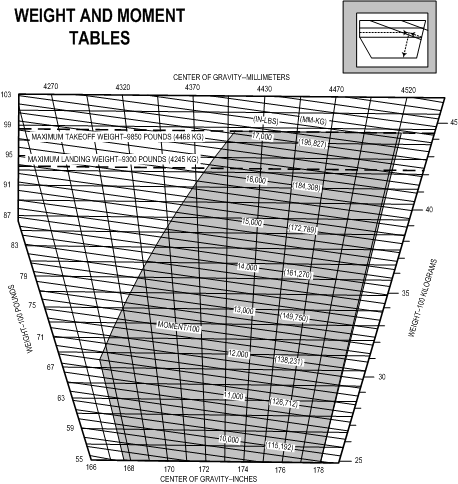
Most aircraft have a center of gravity (CG) envelope similar to:


Where as the aircraft gets heavier, some weight may not be allowed too far forward or aft (the angles at the top of the graph). The seats are usually in the middle of the graph and the front and rear cargo holds are the front and rear limits of the chart. 

If the aircraft is loaded outside of the envelope, the aircraft will have control issues. Too far aft, and the elevator may not be able to keep the nose down. Too far forward, and the elevator may not be able to lift the nose off the runway. 

There are two points that need to be close to fly stable. The center of lift (where all the lift vectors converge) and the center of gravity (where all the weight vectors converge). If the CG and CoL are exactly at the same point, the aircraft may fly fine. If there is an engine out, with the CoL and CG together, it may be more difficult to glide. Most aircraft fly with the CG ahead of the CoL as a safety precaution. With the CG ahead of the CoL, the nose will drop to help maintain airspeed, and the aircraft will glide nicely with an engine out. 

Moving the CG too far forward will cause extra fuel burn. The elevator will have to push down more to keep the nose up. This pushing down is actually adding to the weight the wings are needing to carry, so the aircraft will have to fly at a higher angle of attack, meaning the aircraft will be extra draggy. 

Aircraft are designed with a specific known airfoil. The airfoil has certain characteristics, and the designer will choose one the meets the criteria of the aircraft. The aircraft will have an optimum load point, which we call the CG. The CG in large transport aircraft the optimum point is measured in a mean aerodynamic chord, or percentage of the wing to operate at. There is a range that is safe, a range that is good and a sweet spot where the is minimum trim drag, or up elevator. 

Most transport aircraft have a sweet spot with a high percentage of the bags in the rear of the aircraft. This will minimize fuel burn, and allow quicker loading of the aircraft. 

FYI  


Saturday, September 5, 2015

Electrical System Basics

This post is about electrical system basics, what powers what and why. Not all aircraft have electrical systems, but the ones that do, it is all the same.


In a car, there is a battery, mostly used to start the motor. When the motor runs, there is some excess horsepower used to drive an alternator that is used to recharge the battery and run all the electrical systems in the car. If it didn't have enough power to run everything and recharge the battery, the battery would always be dead.

In an aircraft there are batteries that will start the aircraft. Your normal GA aircraft will probably have a single battery that will be enough to start the motor. Some will be 12V and others 24V. The voltage doesn't matter the concept is the same. The battery starts the motor, and the alternator powers all the other systems while recharging the battery. Light jets are similar, but some will have a starter/generator. The starter once the engine is going will become the generator, to power the electrical systems.


In larger jets, like the 737, there will be a battery, but it will be used to start the APU. The APU is a small engine that turns a generator. The APU will generate enough electricity to start the bigger jet engines. The jet engines have starter/generators on them, that will be used to power the whole aircraft and recharge the batteries.

Many times, jets will use a ground power unit (GPU). This is a cart with an engine and generator or interface to mains power that will be used to power the aircraft while on the ground, and can be used to start the aircraft.

Once the aircraft is powered, there are many systems. These systems can include avionics, entertainment, lighting, etc. Each of these systems will have one or more circuits. Each circuit will be protected with a fuse or circuit breaker (or an electronic equivalent). The circuit protection device is there to prevent fires. The size of the circuit protector is related to the size of the wire going to the circuit. In an aircraft smaller wires mean less weight, so using the right size is critical.


As current flows through a wire, there is resistance. Copper has very low resistance, but not zero. That resistance to the current flowing translates into heat. If the wire cannot dissipate the heat generated, it will transfer the heat to the insulation, potentially melting that. If the insulation melts, and maybe melts the wire next to it, or as the wire passes through a bulkhead and can conduct to the metal airframe, even more current will flow causing even more heat, and maybe something near by will catch fire.

The circuit protector should interrupt the current flowing in the wire before the insulation begins to melt. If the current isn't flowing there is no heat. If there is no heat, there is no fire (or melting insulation causing smoke, etc).

Sometimes things go wrong outside of this. UV rays can cause wire insulation to become brittle (older insulation), and then vibrations would cause the insulation to flake off. This may not be too much of a problem, but it may allow wires to touch, and then the current protection may not work properly. Imagine a 20 amp circuit next to a 5 amp circuit, and the 5 and 20 amp wires touch. The 5 amp fuse will do nothing because the 20amp circuit has taken up the load). Similar problems have happened, and fires break out even though the systems seem to be properly designed.

Should pilots be allowed to switch off circuits in flight? If smoke is in the cockpit, and it seems to be electrical, I believe they should be. Should pilots spend any time troubleshooting trying this circuit or that? I don't think so. If a pilot needs something to complete the flight, they should be allowed to try once, but once a  circuit is turned off, it should be left off. As much as possible, aircraft systems should be designed to enhance the pilots skills, not override it. When things go wrong, pilots need to land as soon as practicable, and have the systems checked out while safely on the ground.


Thursday, August 6, 2015

AM or FM

For young people, probably born before 2000 (1995?) the idea of AM radio is something they really don't know about. Even in the car, most people don't listen to AM radio any more. The audio quality is much lower on AM than on FM.


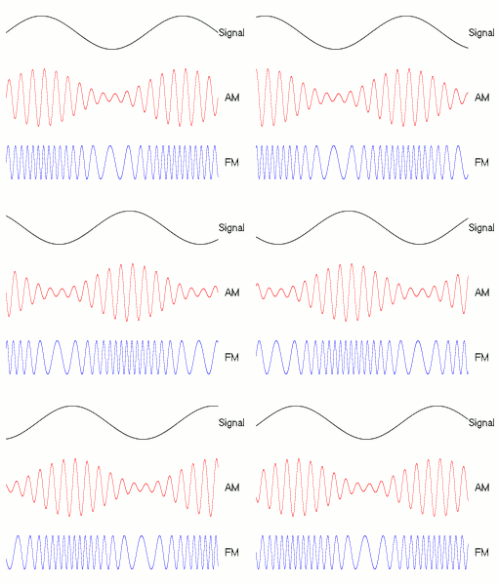
AM stands for Amplitude Modulation, FM stands for Frequency Modulation. The modulation has to do with converting a radio frequency carrier into sound. Amplitude Modulation uses the carrier power to cause sound, where Frequency Modulation changes the carrier frequency to cause sound. A radio carrier will typically be a constant frequency and amplitude. A 100MHz radio signal may be broadcast at 100 watts of power. Changes to the carrier at the transmitter can make the receiver change sounds. Changing the amplitude (100 watts +/- 100mw) may make a sound). Changing the frequency (100MHz +/- 20KHz ) will probably also change the sound at the receiver.


Aircraft VHF radios are on AM. Communications with the tower, or aircraft to aircraft is done using AM, like the AM radio in a car. The radios usually work on the 108-140MHz range, which is just above the FM radio in a car (85MHz-108MHz).

The biggest advantage of AM over FM for aircraft communication is when two people try to talk at once. An AM signal of equal strength at the receiver will make a squeal. If one signal over powers the other (IE aircraft is closer to a transmitter) the receiver will hear the closer signal, and may hear the other one as well (possibly making things jumbled). When two FM transmitters of similar strength are received, the radio will only sound like a blank carrier, or white noise. Certainly the receiver will have no idea if someone had a hot mic and sent nothing, or it was two aircraft talking at once.

To change from AM to FM would be a bad idea. People suggest it all the time, the audio in the car shows FM sounds better than FM. The transition would be very expensive, and require all ground stations and aircraft to change on the same day.  AM was chosen because it was easier to work with when aircraft radios were first becoming popular. There would be less clarity on busy frequencies if everything switched to FM.

Newer digital modulation schemes (IE VHDL) will allow more selection. Ground to aircraft radio communications will typically be to a specific aircraft, and prevent the party line that we have today. The party line is helpful, allowing pilots to second guess controller instructions. One pilot may hear a conflicting instruction for two different aircraft, minimizing incidents. The other side of that is sometimes pilots hear instructions meant for another aircraft as instructions for them (IE SWA123 and NWA123 could be on the same frequency).

AM vs FM, what do you prefer?


Monday, July 27, 2015

Talking to Ourselves...

I listen and follow most of the social media, podcasts and some blogs about aviation. Most people are saying the same thing, pilot population is heading down. There are discussions about why this or that, and what laws can be changed to make things better. Some things may help, some may not.

The reality is, we are all talking to ourselves. We talk about flying, and how to get new people involved in aviation. We don't always get to do something about it.

When I was a kid my neighbor was a pilot. He took my dad flying, and his kids flying. I never got to go, but between the stories that my dad told, and his kids told, I really wanted to go flying. I was able to go for rides with my high school buddies, splitting costs and such, but never on my own. I knew I wanted to be a pilot.

My kids tended to be ambivalent towards flying. The first trip we took was in a C-172 from Minneapolis to Billings MT. I don't think I scared them, they were too young to remember how long, hot and awful that trip was (lost an alternator, had a dust storm in Wyoming, and a couple other issues).

Last week I took them to Oshkosh. I think they were just along for the ride to appease me. "Yea, dad we'll go" they kept saying. Getting the car loaded up was difficult, and there was lots of discussions. I wanted to not take them, but that would end my trip, and I wanted to go. I sucked it up, and started driving.

Where we live is close to a largish GA airport. There are plenty of normal looking aircraft, jets, trainers and everything in between. When we got in the gate at Oshkosh, they saw the Cessna and Raytheon display, with all the same aircraft as at our airport. On the right was Aviat and Champs, and others. They were still bored. The next display on the left was the Icon A5, and they just lit up. "Dad, this is the airplane you should buy!". It made me happy that they liked something.

We kept looking, and they stuck their heads in the bomb bay of the B-52, and poked and prodded other aircraft in the main pavilion, and were somewhat interested.  We looked at homebuilts and some of the factory built planes. They weren't there to appease me any more, they were getting something out of this. We went to the Museum and they asked questions about the various airplanes. We got to see the end of Dick Rutan's discussion of the Voyager, and my son went up and talked to Dick. They chatted for a while, and Dick told him the Voyager didn't fly so well, and other things, I didn't hear. Finally he got Dicks autograph, his cherished souvenir.

Then they watched the airshow. My older son saw Mike Gougain perform. He was really impressed, and focused. He asked if I could do that, all I could say is, "I've done some aerobatics, nothing like that".

So then the questions started, what does it take to learn to fly? when can I start? Sunday evening, he turned on the TV and started watching Red Bull Air Races. I will help him get started, but I think he needs to put some effort into making it happen. I'd hate to give him the PPL and have him think that was easy, and only go often enough to be dangerous. He needs to appreciate it.

What can I say, take people to the airport is how to get people interested in flying. Bring 'em into a cockpit. I've taken friends flying,  had boy scouts in my plane, I've flown young eagles, I've done what I could to get as many people thinking positively about flying. If I would have gone to Oshkosh alone, my kids would still be ambivalent, and not thinking about flying. Next time you are going to the airport, even if not to fly, invite someone to come with.

Just Do It!


Tuesday, July 14, 2015

Twins Really Have 3 Engines; APUs RATs and emergency items

Most twin engine transport aircraft (IE 737, 777, A320, etc) really have 3 engines. The third engine is usually in the tail, and provides almost no thrust. The third engine is generally small (compared to the two engines on the wings) and is called the Auxiliary Power Unit (APU). This APU will provide the aircraft with electricity, air and maybe hydraulic power in the event the wing engines are unable to power the electrical needs of the aircraft.

The APU is a turbine engine, a small jet engine that will provide various resources, like a generator. The APU will use the fuel from the tanks on the aircraft. The engine runs at a constant speed, so there are no throttle controls. There are various gauges to monitor the performance of the engine and the accessories.

The APU can generate enough power to start the larger engines, so it may be running while the aircraft is on the ground. The APU may also provide conditioned air for the aircraft at the gate. The APU can be started using batteries or from the generators on the main engines. Some APUs have separate started batteries from the aircraft other batteries, depending on aircraft needs.

The APU is available for emergency needs. If the aircraft engines are unable to provide air conditioning and pressurization, the APU may be used for that. If the main generators have failed, the APU may provide electricity for the aircraft.

Various scenarios are possible. A maximum performance takeoff will require bleed air from the main engines to be cut off, and the APU can provide pressurization in that case. MELs may allow an aircraft to fly with a single operating generator if the APU is available. Sometimes both generators will fail, and the APU can take the load. For ETOP operations, the APU may need to be running for a portion of the flight (depending on operating limitations).

APUs fail, sometimes. The APU uses fuel, and people are very conscious of fuel consumption, so they are not used all the time. An APU may sit idle for days on certain aircraft, and when they are needed, they don't work, won't start, batteries are dead. The need is still there, so most aircraft have another backup device for emergency electricity generation, called the Ram Air Turbine (RAT).

The RAT is capable of powering enough of the aircraft to get it on the ground. This is a last final device for when things are going bad. The RAT is a propeller attached to a generator that will drop down into the slipstream air close to the fuselage. The electricity will be used to power the pilots PFD and whatever else the pilots need (IE fly by wire system).

The twin aircraft will have two generators, one on each engine. The APU will be there if one or more of those generators fail, and some aircraft have a RAT if all the other generators fail. There is proably no good reason for a pilot not to be able to land a plane if all the electrical systems are out. Will that help you fly more comfortably?


Saturday, May 23, 2015

Turn By Turn Navigation

These are some thoughts I've had recently about autopilots and EFBs and other avionics in the plane. Some are silly, but I think some might have a place, I just don't know how to quantify them. I sort of got this idea when reading about pilots missing stuff, and how close we are o having reliable Human Machine Interface (HMI).

In the car, having turn by turn navigation is pretty handy, when going somewhere unfamiliar. Sometimes roads are close together, and turns are confusing, especially the signs offering help. In the air, if navigating on airways, it is less confusing, but sometimes we don't remember if the turn to was 135 or 145 degrees. Autopilots can help, it has the plan, and if it missed the turn, it will fly a correction course. Maybe having a voice say "turn to heading 135 in a quarter mile" won't help. How about a voice to read the latest winds for the area we are in "winds 220 at 35", it might be good to know, especially if fuel is burning quicker than plan. I was thinking more on final, if the winds are changing, and AWOS is updating quickly, maybe that would be a handy bit of information. The volume would have to be low, or the tone of the voice would have to be just right to overcome what ever other noise may be happening.

The FAA has started more and more data link facilities. CPDLC is being made available to more and more aircraft. Push that further, and start looking at CDM, so the aircraft can fly the straight line. For many reasons, a flight should plan to use waypoints and stay on airways, but how about once airborne, the pilot be allowed to ask for direct to the destination. If the Primary Flight Display (PFD) had a button, "ask for Direct", that would query the FAA URET system, and make a plan that might work.

The connected cockpit has many people worried. Will hackers be able to fly the airplane, is always the worry. Certainly smart people are worried about it, and they won't let it happen. There might be people in the company that don't worry about it, and can show all the economic reasons to just hook the autopilot to the passenger WiFi, but none of the engineers will let it happen. Perhaps when no one is in the cockpit, all the systems will be on one network, but I hope not.

Writing the blog is certainly refreshing. Yesterday my thoughts were really out there, but having a day or so to temper the thoughts, I've managed to narrow things down to some practical thoughts. Hopefully my thoughts will bring you some ideas.


Monday, May 11, 2015

2 vs 4 is Less Better?

There is a lot of talk about the end of 4 engine jets. They just aren't economical people are saying. Kinda sort maybe I guess common sense would say "they" are right, in some ways, but this is aviation, and things are complicated.


The thinking is two engine operations is more efficient than 4 engine operation. Yes, running 4 engines will use more fuel than running two engines, for most aircraft. The thing is, 4 engine aircraft haul more, so thinking of cost per available seat, things aren't black and white. Wikipedia has a great chart comparing various modern aircraft. http://en.wikipedia.org/wiki/Fuel_economy_in_aircraft

This page has some good comparisons. Looking at the column to the far right labeled "Fuel efficiency per seat" you will see, especially in the jets built since 1997, most of the jets in the medium haul (transatlantic) will get about 90+ miles per gallon per seat (mpg). Even in the transpacific (long haul chart) the jets are all pushing 70-100 mpg per seat. The reason the economy goes down for the longer flights is because the jets must carry the fuel longer.

(the chart has a couple outliers, any jet that hasn't flown yet (IE first flight > 2015) you can't really count, the numbers are estimates). Newer jets are much more efficient than older jets.

Comparing things, is more complicated than the charts may indicate. Thinking about a New York to London flight, and using a 747-8 with 467 seats at 91mpg or a 787-9 with 304 seats at 99mpg it would seem that the 787-9 wins every time. 2 engines means less maintenance, and less fuel, so it should win. To buy a 787-9 will set you back about $250million, where the 747-8 will cost about $357million. The 787 still wins, right. Well again it is complicated.

No one sells all the seats on the aircraft, so assuming a 95% load factor, 3400 miles (JFK-LHR) in big round numbers, the 787 will use 10440 gallons of fuel, where the 747 will use 17450 gallons. With only 289 folks on the 787, the mpg drops to 94mpg and the 747 with 444 folks on the 747 the jet only gets 87 mpg per seat.

The 747 is hauling about 35% more passengers per flight, so 3 flights of the 747 would equal 4 flights of the 787, This is where the numbers aren't very general, but you can see that on popular routes where the load factors are high, the 747 may actually win. Less boarding time to load 3 flights, less taxi time. The fuel efficiency that I have shown here only counts the cruise portion of the flight, climb is very expensive. There are landing fees, and gate fees that need to be accounted for.

Fuzzy things though include maintenance. The aluminium 747 can be maintained by most maintenance facilities, where the composite 787 may need special maintenance facilities. More engines may mean more expense, but they are smaller engines, so there could be less cost handling them.

My goal here isn't to show the 747 is more efficient, my goal here was to show it may not be the end of the line for the four engine jets, just yet. There is still time for them, they aren't hugely inefficient, and may offer economies that may not be completely obvious.


Wednesday, April 15, 2015

ADS-B the Moving Target

Everyone in aviation has heard the FAA is pushing for a 2020 deadline. The FAA plan is on Jan 1 2020, all aircraft (except gliders) must have ADS-B out that will use Class A,B, C and D airspace in the US. The AEA is on board, and their members are excited about selling equipment to the aircraft that will need it. There are estimations that between 5,000 and 10,000 aircraft will need new equipment to meet this deadline. (365 X 5 = 1825 days and 5 aircraft a day, yea, they are right, we can do it).

It is complicated though. 


There are two paths to certification for aircraft, the DO-260B way, where the transponder on the aircraft is made to meet the 1090ES standard, and the DO-282 way where the aircraft gets a UAT added. The DO-260B is supposed to be an easy upgrade for mode S equipped aircraft like large transports.

I worked on a project where the desire was to upgrade the GPS on some 737's. The manufacturer of the GPS said no trouble. The 737-NG's have an integrated radio system, where Honeywell supplies the whole package. To change the GPS receivers would require Honeywell to recertify the whole radio system, and that would be expensive.

For both ADS-B systems (DO-260 and DO-282) the GPS must meet certain performance requirements, similar to the WAAS (GBAS) GPS systems. Most new systems are including a WAAS capable GPS receiver in the transponders or UAT and are meeting the standard. For existing systems, there may not be a WAAS level performance system available. On transport aircraft, the IRU may allow meeting the performance needed for the position information. The IRU is capable of being very accurate, since the autopilot relies on this information. Combining the IRU and the GPS may allow the accuracy necessary within the 90% required.

The FAA meant the best


The 2020 deadline for ADS-B out was established as part of the 2010 FAA  re-authorization package. The FAA promised to have all the ADS-B ground stations in place by the end of 2013. Everyone thought 10 years would be plenty of time. The FAA mostly made the 2013 deadline. Most of this had been tested in the early 2000's in Alaska as part of the capstone project.

The equipment manufacturers had some equipment available shortly after 2013, and some installations were happening. The road to certification of the equipment was a little slow in coming, and there seemed to be challenges. In 2014 there were a couple ADS-B in and out solutions that were certified, but still very expensive.

The FAA found out they goofed. The certification requirements are not possible on all aircraft. The experimental aircraft are not type certificated. They cannot receive a supplemental type certificate (STC), there is not a certificate to supplement. The FAA had made an exception for experimental aircraft, they don't need TSO'd equipment, and they don't need an STC. Now the LSA aircraft are not certificated either. LSA's must have manufacturers approved configurations to be airworthy. The manufacturers must determine if a configuration is safe and airworthy, so they must test ADS-B devices to allow their customers to conform.

There are other parts of the rules that are proving a challenge. Occasionally an aircraft will not have a good GPS signal due to terrain or buildings. If the transponder indicates a failure, because of no GPS, the aircraft cannot take off. The trouble may not be with the aircraft, it may just be terrain. The FAA is working to address these types of issues.

The equipment available today is first generation. Buying something in 2015 will almost certainly look old come 2020. If the equipment is ADS-B in and out, the MFD and software will probably look somewhat outdated in 2020. Second generation equipment is being talked about already. The second generation will probably have faster processors and more efficient radios, making the first gen equipment feel less capable.

The airlines are in a tough spot. Most transport aircraft were designed well before ADS-B mandate was finalized. The equipment on most aircraft do not meet the requirements, and changing anything will be expensive. The paperwork may take 1-3 years, and then the work may begin. With over 5800 registered transport aircraft in the US, the 2020 deadline looks daunting.

The FAA may offer a grace period


There are rumors coming out of Washington that that FAA is considering a 5 year grace period. The 5 years is what people believe it will take to properly equip the transport aircraft with conforming equipment. During the transition period, the aircraft will be allowed to use the existing GPS and IRU equipment to broadcast the ADS-B position, at a lower precision than will be required after 2025.

The FAA has for the last year insisted the 2020 deadline would not budge. The grace period might be a way for the FAA to save face, and allow a more reasonable deadline.


Tuesday, March 31, 2015

The AOPA Is On Board! (finally)

The FAA wants to move forward. On October 1, the FAA wants to move forward with the flight plan form change for everyone. The airlines have mostly moved forward to use only the ICAO format since about 2008, for all flights.


Today the AOPA agreed that maybe it is time to retire that old friend 7233-1. Yes, that is the old flight plan form that we all grew up with (unless you are in another country, or went straight to a major Airline from a good flight school). You may even send AOPA your comments: airtrafficservices@aopa.org

The Association has a quick video about the changes.

http://www.aopa.org/News-and-Video/All-News/2015/March/26/Changes-to-Flight-Services-planned


It is no secret that I have been trying to get rid of the 7233 form. The ICAO for, looks intimidating, but is really simple once you look at it. Everything before the "FPL" is not needed and everything after field 18 is optional. The stuff translates pretty well, starting in field 7, aircraft ID is either the N number or the flight number that the ATC will know the aircraft as. Field 8 is the flight rules and type, IFR or VFR, just put an "I" or a "V" in the box, the type is GA (G), Military (M), Scheduled (S), Non-scheduled (N) and Other (X). Field 9 is the number, type and wake turbulence class, put more than 1 if this plan is for a group of aircraft, the type is C172, A36, or whatever your aircraft type is per ICAO 8643, and the wake turbulence is Heavy, Medium or Light depending on aircraft weight.

Field 10 is the big winner in this form. What does a /U represent on the old 7233-1 form? Well field 10 there is no guessing. The equipment you want to use on this flight can be specified here, in all it's glory. Got a VHF comm radio, put a V there. Have a VOR Nav radio, put in a O (vOr), how ab out GPS, put in a G.  If your aircraft has CPDLC use a J with some numbers depending on your type to put here, Mostly, the letters for the common stuff are:


  • A - GPS Landing system
  • F - ADF
  • G - GPS (or other global navigation system)
  • H - HF radio 
  • I - Inertial Navigation
  • L - ILS
  • O - VOR
  • P - Performance Based Navigation (can include various RNAV equipment see FAA Doc 9613)
  • V - VHF radio (12kHz spacing)
  • W - RVSM

Field 10 also includes the type of transponder the aircraft will use. The common values are:

A - Mode A only (squawk code only)
C - Mode A/C (altitude encoding)
E - Mode S with extended squitter (ADS-B)
S - Mode S with altitude and aircraft ID
N - No transponder

There is no field 11, 12 or 14, so there is even less to fill out!

Field 13 is where the flight originated from, all four letters/numbers ICAO format (IE KORD) and time in UTC.
Field 15  Cruise Speed, Level and Route. This is probably the most flexible part, especially the route.
The cruise speed is the cruise speed the aircraft will initially be flying at once at cruise altitude. The Level is the altitude the aircraft will fly at, preceded by the type of information. For flight levels, use an F and the flight level (IE for flight level 180, put F180), or for hundreds of feet use an A followed by the feet (IE for 8500 feet, use A085). The route will be all the waypoints between the departure airport and the destination airport. These waypoints can be specific named waypoints (IE MINEE), lat/lon coordinates (IE 46 degrees 20 minutes N 78 degrees 5 minutes west would be specified as 4620N07805W), or fix radial distance (FRD) coordinates (IE 30 miles south of the Kankakee IL VOR would be specified IKK18030).

Field 16 is the destination, the Estimated Enroute Time (not the arrival time) and the first and second alternates if needed. If it will take 2.5 hours to get to Oshkosh, field 16 will be KOSH0230, if you need to use Milwaukee for an alternate, then the field 16 is KOSH0230 KMKE.

There is no field 17 either, so there is even less to fill out.

Field 18 is labeled "Other Information" which seems casual, but it is really formatted other information. I hinted that if in field 10 the aircraft is RNAV capable a note can be added to field 18 to tell the ATC what kind of approach you may want, as in: NAV/RNVD2 to use a GPS receiver to do a 1 mile approach. (RNP will take specific pilot training). If you just want a note to be put on the flight plan, the RMK/ can be used followed by the text of the message. Other specific field 18 values are:


  • HAZMAT: For a flight carrying hazardous material;
  • HOSP: For a medical flight declared by medical authorities
  • MEDEVAC: For a life critical medical emergency evacuation
  • SAR: For a flight engaged in a search and rescue mission

The one place that gets ugly is the ADS-B specifications. If the aircraft ADS-B installation is DO-260B then the field 18 must contain SUR/260B or if the ADS-B installation is DO-282B compliant then SUR/282B should be specified in field 18, (DO-260B is the specification for a Mode S transponder with Extended Squitter or 1090ES, DO-282B is the specification for UAT radios). I hope that clears that mess up.

An example field 18 can look something like:

   SAR NAV/RNVD2 SUR/282B RMK/Aint we got fun

That would be a search and rescue flight with GPS capable of RNAV 1, using ADS/B UAT radio, telling the controller we might be having fun.

Are we ready for fall? That is when this all will be happening.

Saturday, February 7, 2015

No One In The Cockpit

There are still studies going forward about letting large aircraft fly with passengers and cargo, with one or no pilots. Some people say it is inevitable, thinking back to the days of professional drivers, or elevator operators, pilots are just an extra expense the airlines can get by without. Technology has improved, it does seem like the pilots don't need to fly the airplane as much as they used to. I've explained how software reliability has improved, and the tools needed to build new autopilots are getting better.

Looking at Air France 447 might be a good place to start. That airplane was apparently flown into the ocean by a pilot, that was confused. The autopilot should have done better, one would think. If the timeline is followed, it will show that the autopilot was confused, and gave up as well (alternate law), relinquishing control to the human pilots. The airspeed sensors (pitot tubes) apparently iced over, causing the automated systems to not have enough correlated information to process the data it had. The pilots left in the cockpit to monitor the systems were not experienced enough to know what to do in this situation.

Talking to most pilots, they will tell you about automation failures all the time. Sometimes stuff just breaks. I know two pilots that were flying back and forth Houston to Austin one day for an airline, and they decided to hand fly the trips and let a flight attendant judge who flew smoother. The next day the one pilot had to take that same airplane from Houston to Orlando, and it turned out the autopilot had failed sometime the day before, and no one knew it broke. He had to hand fly the plane from Houston to Orlando.

The idea of a single pilot in the cockpit is probably just as bad as no pilots. Sometimes pilots have troubles, including health (getting sick, incapacitated, etc), alertness, and just plain forgetfulness. Using a second pilot on the ground might seem like a great idea, one pilot can monitor several flights and "take over" if there is a need. The trouble with the ground pilot is the need for 100% reliable automation, and datalinks. If the part that fails in the autopilot is the same part that the ground pilot will be using for controlling the aircraft (IE servo) it won't help to have someone on the ground wanting to control it, the part is broken for whoever is trying to use it.

Thoughts about using pilotless cargo aircraft are perhaps more palatable, since no one will get killed if the automation fails. That will make sense, if everything being shipped has no value. Things shipped by air a typically worth more than things shipped by truck or train (per Cubic Foot). The pilotless aircraft may still crash, and there will be no heroes on board to steer the aircraft away from the stadium full of people.

Economics probably won't make a pilotless aircraft worth it. Certainly automated systems can be built to make things seem to be cheaper. Certainly pilots are paid well, and have health insurance, pensions and vacation pay that must be paid for by customers. An automated system should eliminate the pilots pay from this picture. There will probably be more maintenance, and a higher price for the initial aircraft purchase. Then the insurance picture may remove all the financial benefits.

Oh, and according to the U.S. Labor Department’s Census of Fatal Occupational Injuries, about 27 people per year are killed in elevator accidents in the US.

What is a life worth?


Wednesday, January 14, 2015

DO-260B ... well it is compliant

Ok there is compliant, and there is useful. DO-260B is certainly the former, and not likely the latter. ADS-B is full of challenges, and opportunities. Upgrading equipment is expensive. Some equipment is really close to usable, and some just flat out needs to be replaced. The mode S transponder certainly is one of those items.

If an aircraft has a mode S transponder on it, it can almost do ADS-B out. The payload on a stock mode S transponder can only be 56bits. For ADS-B out, the transponder needs to send 112 bits. The extended squitter (ES) is the change needed to make a mode S transponder ADS-B out compliant. DO-260B is the standard needed to "convert" mode S to mode  S with ES.

ADS-B out is needed by 2020, and if an aircraft has a mode S transponder, getting the transponder updated to DO-260B will  make the aircraft compliant. ADS-B out will make the aircraft as functional as it is today in a RADAR environment. There is no additional functionality available to the pilots on the aircraft. The big win for the pilots is ADS-B in. DO-260B has no provision for IN, only out.

Most 1090ES transponders are only transmitting the ADS-B message. To receive the ADS-B message, a separate receiver is needed. Usually jets will will have the TCAS system as a transponder receiver. This unit has the ability to receive all 1090MHz transponder messages. Using the TCAS receiver may allow an aircraft to have ADS-B in, if it has the proper facilities to send the message to a display, or computer for displaying.

Yes, 2020 seemed a long time away when the FAA said we all need ADS-B out. DO-260B might seem a tempting quick answer for older aircraft. It could be cheap, but likely it will cost a bunch to get a WAAS enabled GPS feeding the mode S transponder with ES. UAT's won't cut it for jets, so the right answer will probably be a new transponder that will do a proper job of handling ADS-B messages, along with a modern WAAS GPS receiver.

I am open to arguments, but overall it is going to cost a lot of money to equip for ADS-B in any aircraft.


Sunday, January 4, 2015

Gate to Gate

Over the last couple years, I have written about many bits of technology that aircraft use. I really haven't discussed too much what bits are used when, and for what. This post, I will try and tie all the items and their use into a comprehensive post. I'll use a commercial airliner (Part 121) for the discussion, both because they typically use more technology, and because that is what my background is. I will also base most of this on flights in the US, to keep it simpler.

We can start a few hours before the flight actually leaves. As the flight approaches it's scheduled time to leave, a group of folks have started planning for the flight. Sure, there is network planning, they set up the schedules and try to be sure the flight will make money, and provide continuity, and such, but that is usually done months in advance. There are also the simulators that the pilots use for proficiency checks, and training, but that is on going and not related to a particular flight, but important none the less.

Dispatchers and meteorologists are considering the situation between the origin and the destination of the flight. The meteorologists are generalists, looking at the weather over the country, where dispatchers are more concerned with the weather along the route between the cities. The dispatcher needs to consider the situation at the specific airports, for runway closures, and other challenges unrelated to weather. There is a tool called Collaborative Decision Making (CDM), where the dispatchers work with the other airlines so everyone can utilize the airports and airspace as optimally as possible.

The dispatchers can use CDM to look for areas to avoid when selecting a route between the two cities. If there is a bad thunderstorm along the optimum route and all the other airlines are avoiding it to the south, the dispatcher may pick a northern route to stay out of everyone elses way. Once the dispatcher selects a route, they need to build the rest of the flight plan. The dispatcher will build a flight plan using many tools. The dispatcher may allow the flight planning engine to select routes, or the amount of fuel. Depending on aircraft maintenance situation, and MEL deferrals and such the flight planning engine can accurately predict the fuel burn based on weather and route.

Once the dispatchers are happy with route and fuel selected, they will file a flight plan. The flight plan will be filed with the Air Navigation Service Provider (ANSP) for both the origin and the destination. For the US the ANSP is the FAA, in Canada is is NavCanada, and in the UK it is NATS. The ANSP handles all the RADAR and air traffic control (ATC) functions. The flight plan will give the ATC controllers a heads up on what the aircraft was planning on doing once in the air.

As the pilots get to the aircraft, one will typically do a walk around of the outside of the aircraft making sure the aircraft looks safe and no damage is visible. The other pilot will typically go to the cockpit and begin setting things up. There may be a the initialization of the FMS, maybe a RAIM check of the GPS, and entering the flight plan prepared by the dispatcher into the FMS. The dispatcher provided flight plan will usually include weather information for the route, and any other non weather realted information for the route (IE ATC changes, etc), The flight plan will also contain fuel and time information that the pilot can double check, insuring the dispatcher hasn't made any mistakes.

When the pilot know the fuel situation, they may confer with the fueler to adjust any fuel amounts to be put on board. The pilot will also need to know how many bags and passengers are on the flight, so they may make proper weight and balance calculations. Some airlines have a load planner who takes care of the weight and balance, others still let the pilot take care of this. Depending on the aircraft, it may be necessary to have a person dedicated to making the load calculations.

As all the passengers are seated, and the pilot is about to move the aircraft, they will ask for permission to move. There may be a ground controller dedicated to the gate area, and there will need to be taxi clearances and such needed from them. Other airports everything is controlled from the tower, and any movement must be cleared through the tower controllers. An ACARs message may be sent requesting the Pre Departure Clearance (PDC), that will be a version of the flight plan sent to the ATC with any ATCneeded changes to the plan. The PDC will also contain the code the pilot needs to enter into the transponder. The pilot must acknowledge receipt of the message.

After the aircraft is taxied to the runway, the pilot will ask the tower for the final airport clearance, by announcing "ready for takeoff". Once the ATC controller gives the pilot final instructions the pilot can access the runway and start the takeoff. The ATC instructions will be the route the pilot should take to get from the runway to the beginning of the flight plan route. Every bit of the instructions and plans for the takeoff are there in case there is a failure. If there is a radio failure either from ATC or the Aircraft, the instructions given are good enough for the pilot to take off, fly the planned route, and approach the destination. It is a safety situation, should the plan be the safest and most expeditious way to fly the route.

Once the aircraft is above about 300 ft, depending on the  airport, the aircraft will appear on RADAR. The first RADAR that will show the aircraft is the TRACON, who will control the aircraft after tower hands off the aircraft. The TRACON controller will control the aircraft until it is more than 30-50 miles from the airport. The TRACON will hand the aircraft off the enroute controllers who will control the flight until it is 30-60 miles from the destination airport. The RADAR data will be collected and sent to the FAA command center for others to view, and use the ADSI information. As we move into NextGen, there may be more ADS/B position reporting, instead of RADAR.

Once the aircraft is on the route, the pilots will typically engage the autopilot. The autopilot will help maintain the route of flight, altitude and throttle settings to insure the aircraft flies the route planned, and uses the fuel planned. The pilot must monitor the autopilot to be sure it is engaged, and doing the right thing the whole flight. Occasionally pilots will hand fly the aircraft, for practice. Once in a while the autopilot will fail, and the pilots must had fly the aircraft. The systems in the aircraft are designed for certain reliability levels.

During the enroute portion of the flight, there may be messages the pilots need to send to the company operations center. The pilots will usually send a text message over ACARS if they don't have a lot of urgency to the message. The pilots also have an option for voice communication using company assigned frequencies. If there were to be a medical emergency, the voice communications will be used, if a pilot is looking for a weather report for 400 miles ahead, they will use ACARS.

As the aircraft gets closer to the destination, ATC will typically begin having the aircraft start to descend. Newer approaches follow a continuous descent profile, where the pilots set the throttles to idle at altitude, and basically use the potential energy to glide the aircraft to the runway, reducing noise, fuel burn and pollution.

Current approaches typically are designed for the aircraft to provide it's own guidance. That is there are airs on the ground (or satellite) to provide the aircraft the information it needs to know where it is, and fly to the runway. Features like DME and ILS radions are on the ground, and GPS satellites are in the air.

The enroute controller will hand the flight off to the TRACON controller about 50 miles from the airport, where the aircraft will be below about 10,000ft. The TRACON controller will clear the flight for the approach that it will use to get to the airport. At about 5 miles out, the pilot will be told to contact the tower, and the tower and the pilot will make the final checks and be cleared for the runway to land on. Once on the ground, the pilot will talk to the ground controllers to get to the proper parking area, and maybe a gate controller for certain airports. Once the wheels are chocked, and the engines shutdown, the pilots are mostly done with the flight.

Yes, there is a bit of technology going on between each gate, and a little before. Ever think about that before.

Wednesday, July 30, 2014

The Connected Cockpit

The internet of things (IoT) is kind of the current discussion in many publications. The idea behind the internet of things is that everything will be connected to the internet, allowing monitoring and control of those things. As things are going, it is still too expensive to connect everything to the internet, and there many implications of connecting everything to the internet.


Many aircraft are getting WiFi in the cabin, people think the next step is putting an iPad in the cockpit, and connecting to the cabin WiFi and that should do it. Get all the flight plans, updates, weather and other data from headquarters we are all done. The trouble is, and was pointed out in the first post of this blog, there are security thoughts that need to be considered.

On transport aircraft, most of the cockpit is connected. Well connected, in that the FMS talks to the airopilot, and the EFIS may talk to the ACARS system, and the radios share a common bus. The trouble is, the cockpit is not talking IP, so it isn't easy to connect it to the WiFi, and it probably isn't a good idea.

In your GA business jet, it might be OK to connect the cabin to the cockpit. The people in the aircraft are usually well vetted, and may actually own it. They have a serious reason to be riding in the aircraft to the destination. Smaller aircraft may not have the means to get WiFi to the ground, but WiFi or other Ethernet connections could actually be done allowing the GPS to talk to the ADS-B transciever, and the MFD in the panel.

Allowing the cabin WiFi be connected to the cockpit of a part 121 transport aircraft is probably a bad idea. Probably the biggest problem would be if the aircraft were in a place with weak connection to the ground, and bandwidth was limited, who would get priority, the passenger watching Netflix or the cockpit needing a new route around some weather. The marketing department might argue the passengers, but flight operations department might argue the cockpit should have priority.

The other reason connecting the cockpit to the cabin using WiFi is a bad idea would be straight up security. There would be 100 people in the back bored wondering what is going on in the flight. It may be a curiosity for some, or a goal for others, they may just want to look at things, and manage to get access to say the current flight plan, in the FMS, and accidentally adjust it. Sure there could be firewalls and whitelists and other techniques to keep only the cockpit in the cockpit network, but there are ways for others to get in.

Having a separate cockpit connection to the ground is probably the right answer to the security question. having an isolated cockpit will make it harder to keep the cabin people out of the cockpit network.  It will be important to consider all the connections to the cockpit, and how secure they may be. If there is only an unsecured connection to the cockpit, then the cabin can probably still get to it through some ground station. Worse, if the cockpit doesn't have a secure connection to the ground, now there may be thousands of bored people trying to see what is going on in the aircraft.

Security has to be the first thought when building cockpit connected interfaces. Security through obscurity isn't real security, so proprietary standards won't be a long term solution. Bored people look at proprietary standards as a new challenge, and eventually they get figured out. Using industry best practices will be the only way to insure interoperability along with proper security.

It may be that the aircraft cockpits are only connected using one vendor (IE ARINC as things are today), where they provide an isolated network that only they can get to the aircraft. The messages will have to pass though a filter, and have proper originator white lists. All messages would be encrypted such that only known originators and destinations can see and use the messages. Certainly ARINC can't let Southwest Airlines read Delta Airlines messages, as well as some random person on the ground should not be able to sent messages to any aircraft.

It will take a bit of time for things to shake out, but eventually the cockpits will be connected.

Saturday, July 19, 2014

Thoughts On Cockpit Electronics

Recently I was playing an EFB type app. I think I've mentioned it on my other blog, and I am mostly happy with Avare. This app will allow weather downloads, and is a moving map and can display charts of most types (Sectional, WAC, IFR Low and High, etc). It has built in AF/D, can display approach plates, and topographical data.


While using it, I was surprised by a few things, and it occured to me you cannot just buy the latest technology and go out and blindly rely on it. You really need to know how it works, and test it out for a while.

I flew with the Avare app on a Samsung Note 10.1, and found a few anomalies with the system, and I am sure other apps and tablets have similar anomalies. I was testing the app out while riding in the back of a 737, and the GPS was mostly unusable back there. On takeoff it seemed to work well and I could see the acceleration down the runway, and the climbout was displaying nice. But about the first turn, and suddenly the GPS wasn't working at all. No speed, no heading, nothing. Then it was intermittent the rest of the flight.

Avare, like most moving map applications can take another GPS source as the input. There are several manufacturers that offer standalone GPS source devices (IE Garmin). Avare even offers an app you can run on another device (IE phone) to use that GPS source to feed the application. On my next flight, I ran the external app on my phone, and was feeding Avare with the GPS output from my phone. The phone was in my pocket, and I had a window seat, so it worked almost 100% of the flight.

Since the my phone GPS wasn't 100% reliable, it was a good test. I've mentioned Kalman filters in other posts, I wanted to see if this app had any coast mode, where the application would predict the location based on flight plan and last few samples, but it didn't. When the GPS signal was lost, the airplane on the magenta line would point straight north, and stop updating. This by itself was a good thing to know, since GPS isn't 100% reliable in any situation (see the RAIM predication post), and it is good to know what indication is out there when the GPS signal isn't there. When the GPS data was available again, the airplane symbol oriented itself to the flight path the aircraft was following.

Another test I found out about, the hard way, was the chart updating. The charts are generally current for a period of time, some are 28-56 days (IE approach plates) and others up to about 6 months  (IE sectionals). Some of my charts were out of date. The app has a nice feature allowing bulk downloads of charts, but not while out of WiFi range. Most charts are big files, that take a while to download. Even a 737 with WiFi on board isn't the best place to bulk download charts, since most of the flight may have taken place by the time it updates everything (depending on how many plates are out of date). It is best to do the bulk update the day before the trip, to allow time to make sure everything downloads, and the WiFi at the hotel is reliable, the FAA didn't change anything  and everything else works.

Another problem I found, the 10.1 inch tablet might be too big for a cockpit. If I was flying an A380, it might be fine, but even in the seat in the back of the plane, occasionally it got in the way. It would be nice to try an 8 inch tablet next time. The 10.1 inch tablet is about an inch wider than my knee board on all sides. It might be nice to find a knee board adapter for a tablet. Knowing were it is, and what happens when accidentally touched might be a good thing to know. I tapped the screen multiple times on the flight, and sometimes the screen would go off center, I would have to punch the button to set the center again.

Entering a flight plan on the flight was frustrating at best. For the flights I was on, I could look at the route on flightaware.com, and see what waypoints to enter. I was on a flight from DAL to MSP, that stopped in STL. I needed to enter two separate flight plans, which would have worked much better in the terminal rather than in my seat. Then when I got done, I needed to activate the correct one. At first I had forgotten activate the first plan I entered, so the magenta line didn't show up. The Distance Next and Estimated Time Next were updating as if we were flying a single leg flight.

When we began our approach to the middle airport, I thought I could click on the approach plate, and the app would plot the current position on the plate. It didn't, which made sense after I thought about it, since the approach plates aren't always drawn to scale nor have consistent references, and SIDS and STARS never are drawn to scale. The app was smart, since it knew where we were, and punching the "plate" button brought up the correct airport diagram, and I could select the approach, SID or STAR I wanted to use.  A split screen feature might be nice, especially on a STAR.

The weather feature is nice, since it loads most of the standard weather products, (IE METARs, TAFs, PIREPS) for areas along the route. It wouldn't make sense to get a METAR for Chicago if I am going from Dallas to St Louis, and this seems to do a good job. The weather isn't updated if there is no data connection. Some apps will work with a FIS-B receiver, but even those messages may not be as timely as pilots need in a dynamic system. Talking with Flight Service is still the best way in busy weather systems.

I really enjoyed using the app. I can see it being a tool to rely on. I can also see I need to work with it a bit more, and read the manual. Other similar apps are probably just as good, and will need careful integration into any flying procedures. The FAA doesn't allow using handheld GPS devices for primary navigation in IFR conditions, but for VFR, there should be nothing wrong with using this for navigation.

What do you use?


Monday, June 16, 2014

RAIM and GPS


Wow, I can't believe I haven't written this post yet. I have mentioned RAIM in other posts, but I haven't explicitly explained RAIM. RAIM used to mean Redundant Autonomous Integrity Monitoring it was a technology built into many GPS receivers. TSO-C129 required GPS receivers to have RAIM built in. It would monitor the quality of the GPS signal, and if things were bad enough, the RAIM system would alert the pilot that things aren't working.


If you go back to the NextGen post I did a little more than a year ago, I mentioned RAIM, and the FAA's RAIM prediction tool: http://www.raimprediction.net this tool will predict places in the CONUS where the RAIM alert will go off in the future.

The GPS signal is just telling you what the time was when the satellite sent the signal. The satellites also send location information along with the time. The almanac is the location of all the satellites in the constellation. Knowing the time the satellite sent it's signal, and knowing where the satellite was when the signal was sent, the GPS receivers are able to triangulate (sphere-iate?) their location.

The satellite time message is sent every few minutes, and is susceptible to all kinds of problems. The message may bounce off buildings, mountains or other vehicles causing a wrong distance to be calculated. Other times the satellites will be down for maintenance, and testing, so it won't be available for measurements. Knowing the current status of the constellation is critical to make a valid prediction. Knowing local terrain will help make predictions more accurate.

With GPS Helpers, RAIM prediction is not needed. Using satellite or ground based augmentation systems (IE WAAS, LAAS) the number of satellites isn't as critical. Knowing the WAAS system health is required, and the FAA will issue NOTAMs if the WAAS system isn't up to snuff.

As you can see RAIM has its use, and can make older GPSs more usable.