Showing posts with label VHF. Show all posts

Thursday, August 6, 2015

AM or FM

For young people, probably born before 2000 (1995?) the idea of AM radio is something they really don't know about. Even in the car, most people don't listen to AM radio any more. The audio quality is much lower on AM than on FM.


AM stands for Amplitude Modulation, FM stands for Frequency Modulation. The modulation has to do with converting a radio frequency carrier into sound. Amplitude Modulation uses the carrier power to cause sound, where Frequency Modulation changes the carrier frequency to cause sound. A radio carrier will typically be a constant frequency and amplitude. A 100MHz radio signal may be broadcast at 100 watts of power. Changes to the carrier at the transmitter can make the receiver change sounds. Changing the amplitude (100 watts +/- 100mw) may make a sound). Changing the frequency (100MHz +/- 20KHz ) will probably also change the sound at the receiver.
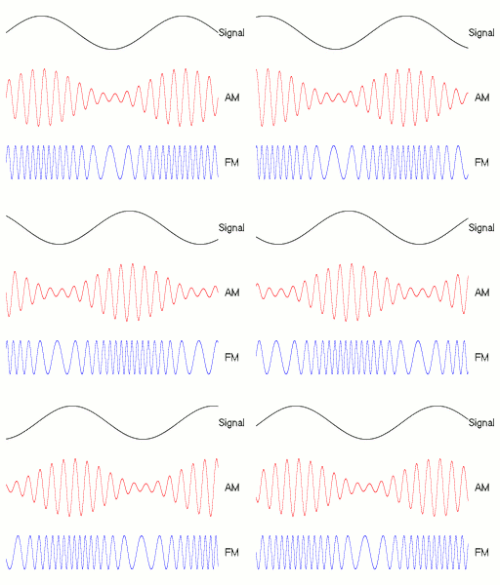


Aircraft VHF radios are on AM. Communications with the tower, or aircraft to aircraft is done using AM, like the AM radio in a car. The radios usually work on the 108-140MHz range, which is just above the FM radio in a car (85MHz-108MHz).

The biggest advantage of AM over FM for aircraft communication is when two people try to talk at once. An AM signal of equal strength at the receiver will make a squeal. If one signal over powers the other (IE aircraft is closer to a transmitter) the receiver will hear the closer signal, and may hear the other one as well (possibly making things jumbled). When two FM transmitters of similar strength are received, the radio will only sound like a blank carrier, or white noise. Certainly the receiver will have no idea if someone had a hot mic and sent nothing, or it was two aircraft talking at once.

To change from AM to FM would be a bad idea. People suggest it all the time, the audio in the car shows FM sounds better than FM. The transition would be very expensive, and require all ground stations and aircraft to change on the same day.  AM was chosen because it was easier to work with when aircraft radios were first becoming popular. There would be less clarity on busy frequencies if everything switched to FM.

Newer digital modulation schemes (IE VHDL) will allow more selection. Ground to aircraft radio communications will typically be to a specific aircraft, and prevent the party line that we have today. The party line is helpful, allowing pilots to second guess controller instructions. One pilot may hear a conflicting instruction for two different aircraft, minimizing incidents. The other side of that is sometimes pilots hear instructions meant for another aircraft as instructions for them (IE SWA123 and NWA123 could be on the same frequency).

AM vs FM, what do you prefer?


Sunday, May 19, 2013

ICAO vs. 7233-1


We all grew up using the plain old FAA flight plan form (7233-1) that was in the AIM or in the manual we got in ground school. It is the information that the FAA says we need in the order they want it right?
Yes, it is still in the AIM, and it will allow us to get flight following, and all kinds of services. It works in the US.

The 7233 form is in need of updates. This form will still let the FAA know if you have a LORAN equipped aircraft, just use the /I, /C, or /Y. The current set of suffix codes allows the controllers to know if the aircraft is RNP capable, using the /R suffix, but doesn't show how the aircraft meets the requirements, of if the aircraft is RNP10, RNP4 or RNP0.1.

How about that fancy question regarding equipment? If the aircraft GPS equipped, a /G should be filed, or still and older plane with only an ILS and DME, what should be filed. The FAA has plans to change many of the equipment suffix codes August 2013. Mostly the FAA isn't going to care about any performance based navigation (PBN) using the 7233 form. Most of the changes only affect aircraft in the flight levels, that are RVSM capable. The big changes are:

All Mode C transponders (at least, including mode S)
  • /Q - RNP (obsolete)
  • /W - RVSM no RNAV (no change)
  • /Z - RVSM and RNAV with no GNSS (new)
  • /L - RVSM GNSS (any GNSS capability is new)
  • /J - RVSM DME/DME/IRU (obsolete, similar to /W)
  • /K - RVSM FMS with DME (obsolete, similar to /W)

The reality is, and the FAA folks in the know will tell you this, the time has come to retire this old friend. Controllers are like pilots, they grew up on this format, and their flight strips will still use some of this format for a couple years, but mostly, they are being trained on something else.

ICAO form

If you have ever flow to Mexico or Canada you probably had to fill out the ICAO flight plan. Canada calls it the Nav Canada form. It looks intimidating, but it leaves a lot of the guess work out of the above form.


Everything before the "FPL" is not needed. There are links to various instructions for filling out this form. Everything after the remarks (Item 18) is optional. The ICAO has a document 4444 "Rules of the Air and Air Traffic Services" about 4000 pages similar to the FAA AIM for both ATC and pilots. Appendixes 2 and 3 cover the flight plan form, and what text to put where. If the above links are followed the form is easy to deal with. 

The big advantage to using this form is specifying your equipment. If your aircraft has at least one Com radio you put in a V (VHF Radio Telephone), if you have a DME, you put a D, if you can fly in RVSM airspace you put in a W. The suffix is either a C for a mode C transponder, S for mode S transponder or an N for no transponder. Then the suffix beyond that would be for ADS/B. PBN levels can be specified using the R in field 10, but the PBN details must be entered in field 18.


You get to tell the FAA exactly what equipment you want to use for your flight, without interpretation and the FAA will pay attention, and let you use it.

That does mean the air traffic controller may put an aircraft on a GPS approach without asking. That should be a good thing, since it is a little more efficient. You can negotiate the ILS or VOR approach if you prefer still. The ATC computers are reading the flight plan, and offering controllers the most efficient reroute based on capabilities specified.

Going Forward


To start using the ICAO flight plan, most of the flight plan filing services will offer ICAO plans is specified. Select that option, and fill out the plan as before. Specific details for the aircraft will need to be specified when setting up the aircraft, but once set, they will continue to be used for plans going forward.

It would be good it the FAA quit publishing the 7233 form, but that doesn't seem to be in the cards any time soon. There are many publications that still refer to the 7233 form, and they also will need to be changed. We are well past the transition phase, most of the FAA employees are familiar with the ICAO form, and are capable of processing instructions in ICAO format.