For young people, probably born before 2000 (1995?) the idea of AM radio is something they really don't know about. Even in the car, most people don't listen to AM radio any more. The audio quality is much lower on AM than on FM.
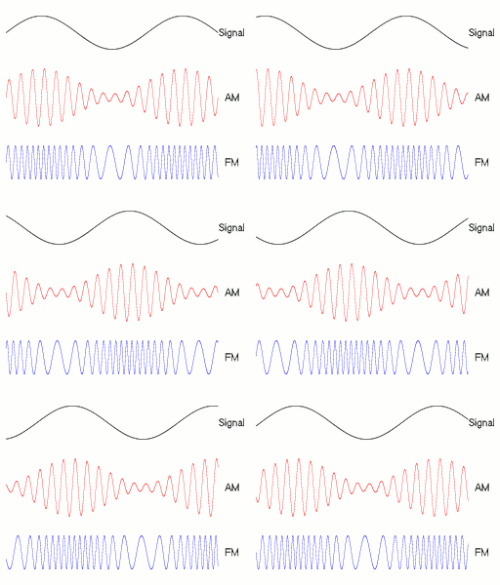
AM stands for Amplitude Modulation, FM stands for Frequency Modulation. The modulation has to do with converting a radio frequency carrier into sound. Amplitude Modulation uses the carrier power to cause sound, where Frequency Modulation changes the carrier frequency to cause sound. A radio carrier will typically be a constant frequency and amplitude. A 100MHz radio signal may be broadcast at 100 watts of power. Changes to the carrier at the transmitter can make the receiver change sounds. Changing the amplitude (100 watts +/- 100mw) may make a sound). Changing the frequency (100MHz +/- 20KHz ) will probably also change the sound at the receiver.
Aircraft VHF radios are on AM. Communications with the tower, or aircraft to aircraft is done using AM, like the AM radio in a car. The radios usually work on the 108-140MHz range, which is just above the FM radio in a car (85MHz-108MHz).
The biggest advantage of AM over FM for aircraft communication is when two people try to talk at once. An AM signal of equal strength at the receiver will make a squeal. If one signal over powers the other (IE aircraft is closer to a transmitter) the receiver will hear the closer signal, and may hear the other one as well (possibly making things jumbled). When two FM transmitters of similar strength are received, the radio will only sound like a blank carrier, or white noise. Certainly the receiver will have no idea if someone had a hot mic and sent nothing, or it was two aircraft talking at once.
To change from AM to FM would be a bad idea. People suggest it all the time, the audio in the car shows FM sounds better than FM. The transition would be very expensive, and require all ground stations and aircraft to change on the same day. AM was chosen because it was easier to work with when aircraft radios were first becoming popular. There would be less clarity on busy frequencies if everything switched to FM.
Newer digital modulation schemes (IE VHDL) will allow more selection. Ground to aircraft radio communications will typically be to a specific aircraft, and prevent the party line that we have today. The party line is helpful, allowing pilots to second guess controller instructions. One pilot may hear a conflicting instruction for two different aircraft, minimizing incidents. The other side of that is sometimes pilots hear instructions meant for another aircraft as instructions for them (IE SWA123 and NWA123 could be on the same frequency).
AM vs FM, what do you prefer?
Discussion of Flying and Technology usually related, but sometimes only one or the other.
Thursday, August 6, 2015
AM or FM
Labels:
Aircraft radio,
AM,
car radio.,
FM,
VHDL,
VHF
Monday, July 27, 2015
Talking to Ourselves...
I listen and follow most of the social media, podcasts and some blogs about aviation. Most people are saying the same thing, pilot population is heading down. There are discussions about why this or that, and what laws can be changed to make things better. Some things may help, some may not.
The reality is, we are all talking to ourselves. We talk about flying, and how to get new people involved in aviation. We don't always get to do something about it.
When I was a kid my neighbor was a pilot. He took my dad flying, and his kids flying. I never got to go, but between the stories that my dad told, and his kids told, I really wanted to go flying. I was able to go for rides with my high school buddies, splitting costs and such, but never on my own. I knew I wanted to be a pilot.
My kids tended to be ambivalent towards flying. The first trip we took was in a C-172 from Minneapolis to Billings MT. I don't think I scared them, they were too young to remember how long, hot and awful that trip was (lost an alternator, had a dust storm in Wyoming, and a couple other issues).
Last week I took them to Oshkosh. I think they were just along for the ride to appease me. "Yea, dad we'll go" they kept saying. Getting the car loaded up was difficult, and there was lots of discussions. I wanted to not take them, but that would end my trip, and I wanted to go. I sucked it up, and started driving.
Where we live is close to a largish GA airport. There are plenty of normal looking aircraft, jets, trainers and everything in between. When we got in the gate at Oshkosh, they saw the Cessna and Raytheon display, with all the same aircraft as at our airport. On the right was Aviat and Champs, and others. They were still bored. The next display on the left was the Icon A5, and they just lit up. "Dad, this is the airplane you should buy!". It made me happy that they liked something.
We kept looking, and they stuck their heads in the bomb bay of the B-52, and poked and prodded other aircraft in the main pavilion, and were somewhat interested. We looked at homebuilts and some of the factory built planes. They weren't there to appease me any more, they were getting something out of this. We went to the Museum and they asked questions about the various airplanes. We got to see the end of Dick Rutan's discussion of the Voyager, and my son went up and talked to Dick. They chatted for a while, and Dick told him the Voyager didn't fly so well, and other things, I didn't hear. Finally he got Dicks autograph, his cherished souvenir.
Then they watched the airshow. My older son saw Mike Gougain perform. He was really impressed, and focused. He asked if I could do that, all I could say is, "I've done some aerobatics, nothing like that".
So then the questions started, what does it take to learn to fly? when can I start? Sunday evening, he turned on the TV and started watching Red Bull Air Races. I will help him get started, but I think he needs to put some effort into making it happen. I'd hate to give him the PPL and have him think that was easy, and only go often enough to be dangerous. He needs to appreciate it.
What can I say, take people to the airport is how to get people interested in flying. Bring 'em into a cockpit. I've taken friends flying, had boy scouts in my plane, I've flown young eagles, I've done what I could to get as many people thinking positively about flying. If I would have gone to Oshkosh alone, my kids would still be ambivalent, and not thinking about flying. Next time you are going to the airport, even if not to fly, invite someone to come with.
Just Do It!
The reality is, we are all talking to ourselves. We talk about flying, and how to get new people involved in aviation. We don't always get to do something about it.
When I was a kid my neighbor was a pilot. He took my dad flying, and his kids flying. I never got to go, but between the stories that my dad told, and his kids told, I really wanted to go flying. I was able to go for rides with my high school buddies, splitting costs and such, but never on my own. I knew I wanted to be a pilot.
My kids tended to be ambivalent towards flying. The first trip we took was in a C-172 from Minneapolis to Billings MT. I don't think I scared them, they were too young to remember how long, hot and awful that trip was (lost an alternator, had a dust storm in Wyoming, and a couple other issues).
Last week I took them to Oshkosh. I think they were just along for the ride to appease me. "Yea, dad we'll go" they kept saying. Getting the car loaded up was difficult, and there was lots of discussions. I wanted to not take them, but that would end my trip, and I wanted to go. I sucked it up, and started driving.
Where we live is close to a largish GA airport. There are plenty of normal looking aircraft, jets, trainers and everything in between. When we got in the gate at Oshkosh, they saw the Cessna and Raytheon display, with all the same aircraft as at our airport. On the right was Aviat and Champs, and others. They were still bored. The next display on the left was the Icon A5, and they just lit up. "Dad, this is the airplane you should buy!". It made me happy that they liked something.
We kept looking, and they stuck their heads in the bomb bay of the B-52, and poked and prodded other aircraft in the main pavilion, and were somewhat interested. We looked at homebuilts and some of the factory built planes. They weren't there to appease me any more, they were getting something out of this. We went to the Museum and they asked questions about the various airplanes. We got to see the end of Dick Rutan's discussion of the Voyager, and my son went up and talked to Dick. They chatted for a while, and Dick told him the Voyager didn't fly so well, and other things, I didn't hear. Finally he got Dicks autograph, his cherished souvenir.
Then they watched the airshow. My older son saw Mike Gougain perform. He was really impressed, and focused. He asked if I could do that, all I could say is, "I've done some aerobatics, nothing like that".
So then the questions started, what does it take to learn to fly? when can I start? Sunday evening, he turned on the TV and started watching Red Bull Air Races. I will help him get started, but I think he needs to put some effort into making it happen. I'd hate to give him the PPL and have him think that was easy, and only go often enough to be dangerous. He needs to appreciate it.
What can I say, take people to the airport is how to get people interested in flying. Bring 'em into a cockpit. I've taken friends flying, had boy scouts in my plane, I've flown young eagles, I've done what I could to get as many people thinking positively about flying. If I would have gone to Oshkosh alone, my kids would still be ambivalent, and not thinking about flying. Next time you are going to the airport, even if not to fly, invite someone to come with.
Just Do It!
Tuesday, July 14, 2015
Twins Really Have 3 Engines; APUs RATs and emergency items
Most twin engine transport aircraft (IE 737, 777, A320, etc) really have 3 engines. The third engine is usually in the tail, and provides almost no thrust. The third engine is generally small (compared to the two engines on the wings) and is called the Auxiliary Power Unit (APU). This APU will provide the aircraft with electricity, air and maybe hydraulic power in the event the wing engines are unable to power the electrical needs of the aircraft.
The APU is a turbine engine, a small jet engine that will provide various resources, like a generator. The APU will use the fuel from the tanks on the aircraft. The engine runs at a constant speed, so there are no throttle controls. There are various gauges to monitor the performance of the engine and the accessories.
The APU can generate enough power to start the larger engines, so it may be running while the aircraft is on the ground. The APU may also provide conditioned air for the aircraft at the gate. The APU can be started using batteries or from the generators on the main engines. Some APUs have separate started batteries from the aircraft other batteries, depending on aircraft needs.
The APU is available for emergency needs. If the aircraft engines are unable to provide air conditioning and pressurization, the APU may be used for that. If the main generators have failed, the APU may provide electricity for the aircraft.
Various scenarios are possible. A maximum performance takeoff will require bleed air from the main engines to be cut off, and the APU can provide pressurization in that case. MELs may allow an aircraft to fly with a single operating generator if the APU is available. Sometimes both generators will fail, and the APU can take the load. For ETOP operations, the APU may need to be running for a portion of the flight (depending on operating limitations).
APUs fail, sometimes. The APU uses fuel, and people are very conscious of fuel consumption, so they are not used all the time. An APU may sit idle for days on certain aircraft, and when they are needed, they don't work, won't start, batteries are dead. The need is still there, so most aircraft have another backup device for emergency electricity generation, called the Ram Air Turbine (RAT).
The RAT is capable of powering enough of the aircraft to get it on the ground. This is a last final device for when things are going bad. The RAT is a propeller attached to a generator that will drop down into the slipstream air close to the fuselage. The electricity will be used to power the pilots PFD and whatever else the pilots need (IE fly by wire system).
The twin aircraft will have two generators, one on each engine. The APU will be there if one or more of those generators fail, and some aircraft have a RAT if all the other generators fail. There is proably no good reason for a pilot not to be able to land a plane if all the electrical systems are out. Will that help you fly more comfortably?
The APU is a turbine engine, a small jet engine that will provide various resources, like a generator. The APU will use the fuel from the tanks on the aircraft. The engine runs at a constant speed, so there are no throttle controls. There are various gauges to monitor the performance of the engine and the accessories.
The APU can generate enough power to start the larger engines, so it may be running while the aircraft is on the ground. The APU may also provide conditioned air for the aircraft at the gate. The APU can be started using batteries or from the generators on the main engines. Some APUs have separate started batteries from the aircraft other batteries, depending on aircraft needs.
The APU is available for emergency needs. If the aircraft engines are unable to provide air conditioning and pressurization, the APU may be used for that. If the main generators have failed, the APU may provide electricity for the aircraft.
Various scenarios are possible. A maximum performance takeoff will require bleed air from the main engines to be cut off, and the APU can provide pressurization in that case. MELs may allow an aircraft to fly with a single operating generator if the APU is available. Sometimes both generators will fail, and the APU can take the load. For ETOP operations, the APU may need to be running for a portion of the flight (depending on operating limitations).
APUs fail, sometimes. The APU uses fuel, and people are very conscious of fuel consumption, so they are not used all the time. An APU may sit idle for days on certain aircraft, and when they are needed, they don't work, won't start, batteries are dead. The need is still there, so most aircraft have another backup device for emergency electricity generation, called the Ram Air Turbine (RAT).
The RAT is capable of powering enough of the aircraft to get it on the ground. This is a last final device for when things are going bad. The RAT is a propeller attached to a generator that will drop down into the slipstream air close to the fuselage. The electricity will be used to power the pilots PFD and whatever else the pilots need (IE fly by wire system).
The twin aircraft will have two generators, one on each engine. The APU will be there if one or more of those generators fail, and some aircraft have a RAT if all the other generators fail. There is proably no good reason for a pilot not to be able to land a plane if all the electrical systems are out. Will that help you fly more comfortably?
Saturday, May 23, 2015
Turn By Turn Navigation
These are some thoughts I've had recently about autopilots and EFBs and other avionics in the plane. Some are silly, but I think some might have a place, I just don't know how to quantify them. I sort of got this idea when reading about pilots missing stuff, and how close we are o having reliable Human Machine Interface (HMI).
In the car, having turn by turn navigation is pretty handy, when going somewhere unfamiliar. Sometimes roads are close together, and turns are confusing, especially the signs offering help. In the air, if navigating on airways, it is less confusing, but sometimes we don't remember if the turn to was 135 or 145 degrees. Autopilots can help, it has the plan, and if it missed the turn, it will fly a correction course. Maybe having a voice say "turn to heading 135 in a quarter mile" won't help. How about a voice to read the latest winds for the area we are in "winds 220 at 35", it might be good to know, especially if fuel is burning quicker than plan. I was thinking more on final, if the winds are changing, and AWOS is updating quickly, maybe that would be a handy bit of information. The volume would have to be low, or the tone of the voice would have to be just right to overcome what ever other noise may be happening.
The FAA has started more and more data link facilities. CPDLC is being made available to more and more aircraft. Push that further, and start looking at CDM, so the aircraft can fly the straight line. For many reasons, a flight should plan to use waypoints and stay on airways, but how about once airborne, the pilot be allowed to ask for direct to the destination. If the Primary Flight Display (PFD) had a button, "ask for Direct", that would query the FAA URET system, and make a plan that might work.
The connected cockpit has many people worried. Will hackers be able to fly the airplane, is always the worry. Certainly smart people are worried about it, and they won't let it happen. There might be people in the company that don't worry about it, and can show all the economic reasons to just hook the autopilot to the passenger WiFi, but none of the engineers will let it happen. Perhaps when no one is in the cockpit, all the systems will be on one network, but I hope not.
Writing the blog is certainly refreshing. Yesterday my thoughts were really out there, but having a day or so to temper the thoughts, I've managed to narrow things down to some practical thoughts. Hopefully my thoughts will bring you some ideas.
In the car, having turn by turn navigation is pretty handy, when going somewhere unfamiliar. Sometimes roads are close together, and turns are confusing, especially the signs offering help. In the air, if navigating on airways, it is less confusing, but sometimes we don't remember if the turn to was 135 or 145 degrees. Autopilots can help, it has the plan, and if it missed the turn, it will fly a correction course. Maybe having a voice say "turn to heading 135 in a quarter mile" won't help. How about a voice to read the latest winds for the area we are in "winds 220 at 35", it might be good to know, especially if fuel is burning quicker than plan. I was thinking more on final, if the winds are changing, and AWOS is updating quickly, maybe that would be a handy bit of information. The volume would have to be low, or the tone of the voice would have to be just right to overcome what ever other noise may be happening.
The FAA has started more and more data link facilities. CPDLC is being made available to more and more aircraft. Push that further, and start looking at CDM, so the aircraft can fly the straight line. For many reasons, a flight should plan to use waypoints and stay on airways, but how about once airborne, the pilot be allowed to ask for direct to the destination. If the Primary Flight Display (PFD) had a button, "ask for Direct", that would query the FAA URET system, and make a plan that might work.
The connected cockpit has many people worried. Will hackers be able to fly the airplane, is always the worry. Certainly smart people are worried about it, and they won't let it happen. There might be people in the company that don't worry about it, and can show all the economic reasons to just hook the autopilot to the passenger WiFi, but none of the engineers will let it happen. Perhaps when no one is in the cockpit, all the systems will be on one network, but I hope not.
Writing the blog is certainly refreshing. Yesterday my thoughts were really out there, but having a day or so to temper the thoughts, I've managed to narrow things down to some practical thoughts. Hopefully my thoughts will bring you some ideas.
Monday, May 11, 2015
2 vs 4 is Less Better?
There is a lot of talk about the end of 4 engine jets. They just aren't economical people are saying. Kinda sort maybe I guess common sense would say "they" are right, in some ways, but this is aviation, and things are complicated.
The thinking is two engine operations is more efficient than 4 engine operation. Yes, running 4 engines will use more fuel than running two engines, for most aircraft. The thing is, 4 engine aircraft haul more, so thinking of cost per available seat, things aren't black and white. Wikipedia has a great chart comparing various modern aircraft. http://en.wikipedia.org/wiki/Fuel_economy_in_aircraft
This page has some good comparisons. Looking at the column to the far right labeled "Fuel efficiency per seat" you will see, especially in the jets built since 1997, most of the jets in the medium haul (transatlantic) will get about 90+ miles per gallon per seat (mpg). Even in the transpacific (long haul chart) the jets are all pushing 70-100 mpg per seat. The reason the economy goes down for the longer flights is because the jets must carry the fuel longer.
(the chart has a couple outliers, any jet that hasn't flown yet (IE first flight > 2015) you can't really count, the numbers are estimates). Newer jets are much more efficient than older jets.
Comparing things, is more complicated than the charts may indicate. Thinking about a New York to London flight, and using a 747-8 with 467 seats at 91mpg or a 787-9 with 304 seats at 99mpg it would seem that the 787-9 wins every time. 2 engines means less maintenance, and less fuel, so it should win. To buy a 787-9 will set you back about $250million, where the 747-8 will cost about $357million. The 787 still wins, right. Well again it is complicated.
No one sells all the seats on the aircraft, so assuming a 95% load factor, 3400 miles (JFK-LHR) in big round numbers, the 787 will use 10440 gallons of fuel, where the 747 will use 17450 gallons. With only 289 folks on the 787, the mpg drops to 94mpg and the 747 with 444 folks on the 747 the jet only gets 87 mpg per seat.
The 747 is hauling about 35% more passengers per flight, so 3 flights of the 747 would equal 4 flights of the 787, This is where the numbers aren't very general, but you can see that on popular routes where the load factors are high, the 747 may actually win. Less boarding time to load 3 flights, less taxi time. The fuel efficiency that I have shown here only counts the cruise portion of the flight, climb is very expensive. There are landing fees, and gate fees that need to be accounted for.
Fuzzy things though include maintenance. The aluminium 747 can be maintained by most maintenance facilities, where the composite 787 may need special maintenance facilities. More engines may mean more expense, but they are smaller engines, so there could be less cost handling them.
My goal here isn't to show the 747 is more efficient, my goal here was to show it may not be the end of the line for the four engine jets, just yet. There is still time for them, they aren't hugely inefficient, and may offer economies that may not be completely obvious.
The thinking is two engine operations is more efficient than 4 engine operation. Yes, running 4 engines will use more fuel than running two engines, for most aircraft. The thing is, 4 engine aircraft haul more, so thinking of cost per available seat, things aren't black and white. Wikipedia has a great chart comparing various modern aircraft. http://en.wikipedia.org/wiki/Fuel_economy_in_aircraft
This page has some good comparisons. Looking at the column to the far right labeled "Fuel efficiency per seat" you will see, especially in the jets built since 1997, most of the jets in the medium haul (transatlantic) will get about 90+ miles per gallon per seat (mpg). Even in the transpacific (long haul chart) the jets are all pushing 70-100 mpg per seat. The reason the economy goes down for the longer flights is because the jets must carry the fuel longer.
(the chart has a couple outliers, any jet that hasn't flown yet (IE first flight > 2015) you can't really count, the numbers are estimates). Newer jets are much more efficient than older jets.
Comparing things, is more complicated than the charts may indicate. Thinking about a New York to London flight, and using a 747-8 with 467 seats at 91mpg or a 787-9 with 304 seats at 99mpg it would seem that the 787-9 wins every time. 2 engines means less maintenance, and less fuel, so it should win. To buy a 787-9 will set you back about $250million, where the 747-8 will cost about $357million. The 787 still wins, right. Well again it is complicated.
No one sells all the seats on the aircraft, so assuming a 95% load factor, 3400 miles (JFK-LHR) in big round numbers, the 787 will use 10440 gallons of fuel, where the 747 will use 17450 gallons. With only 289 folks on the 787, the mpg drops to 94mpg and the 747 with 444 folks on the 747 the jet only gets 87 mpg per seat.
The 747 is hauling about 35% more passengers per flight, so 3 flights of the 747 would equal 4 flights of the 787, This is where the numbers aren't very general, but you can see that on popular routes where the load factors are high, the 747 may actually win. Less boarding time to load 3 flights, less taxi time. The fuel efficiency that I have shown here only counts the cruise portion of the flight, climb is very expensive. There are landing fees, and gate fees that need to be accounted for.
Fuzzy things though include maintenance. The aluminium 747 can be maintained by most maintenance facilities, where the composite 787 may need special maintenance facilities. More engines may mean more expense, but they are smaller engines, so there could be less cost handling them.
My goal here isn't to show the 747 is more efficient, my goal here was to show it may not be the end of the line for the four engine jets, just yet. There is still time for them, they aren't hugely inefficient, and may offer economies that may not be completely obvious.
Wednesday, April 15, 2015
ADS-B the Moving Target
Everyone in aviation has heard the FAA is pushing for a 2020 deadline. The FAA plan is on Jan 1 2020, all aircraft (except gliders) must have ADS-B out that will use Class A,B, C and D airspace in the US. The AEA is on board, and their members are excited about selling equipment to the aircraft that will need it. There are estimations that between 5,000 and 10,000 aircraft will need new equipment to meet this deadline. (365 X 5 = 1825 days and 5 aircraft a day, yea, they are right, we can do it).
There are two paths to certification for aircraft, the DO-260B way, where the transponder on the aircraft is made to meet the 1090ES standard, and the DO-282 way where the aircraft gets a UAT added. The DO-260B is supposed to be an easy upgrade for mode S equipped aircraft like large transports.
I worked on a project where the desire was to upgrade the GPS on some 737's. The manufacturer of the GPS said no trouble. The 737-NG's have an integrated radio system, where Honeywell supplies the whole package. To change the GPS receivers would require Honeywell to recertify the whole radio system, and that would be expensive.
For both ADS-B systems (DO-260 and DO-282) the GPS must meet certain performance requirements, similar to the WAAS (GBAS) GPS systems. Most new systems are including a WAAS capable GPS receiver in the transponders or UAT and are meeting the standard. For existing systems, there may not be a WAAS level performance system available. On transport aircraft, the IRU may allow meeting the performance needed for the position information. The IRU is capable of being very accurate, since the autopilot relies on this information. Combining the IRU and the GPS may allow the accuracy necessary within the 90% required.
The 2020 deadline for ADS-B out was established as part of the 2010 FAA re-authorization package. The FAA promised to have all the ADS-B ground stations in place by the end of 2013. Everyone thought 10 years would be plenty of time. The FAA mostly made the 2013 deadline. Most of this had been tested in the early 2000's in Alaska as part of the capstone project.
The equipment manufacturers had some equipment available shortly after 2013, and some installations were happening. The road to certification of the equipment was a little slow in coming, and there seemed to be challenges. In 2014 there were a couple ADS-B in and out solutions that were certified, but still very expensive.
The FAA found out they goofed. The certification requirements are not possible on all aircraft. The experimental aircraft are not type certificated. They cannot receive a supplemental type certificate (STC), there is not a certificate to supplement. The FAA had made an exception for experimental aircraft, they don't need TSO'd equipment, and they don't need an STC. Now the LSA aircraft are not certificated either. LSA's must have manufacturers approved configurations to be airworthy. The manufacturers must determine if a configuration is safe and airworthy, so they must test ADS-B devices to allow their customers to conform.
There are other parts of the rules that are proving a challenge. Occasionally an aircraft will not have a good GPS signal due to terrain or buildings. If the transponder indicates a failure, because of no GPS, the aircraft cannot take off. The trouble may not be with the aircraft, it may just be terrain. The FAA is working to address these types of issues.
The equipment available today is first generation. Buying something in 2015 will almost certainly look old come 2020. If the equipment is ADS-B in and out, the MFD and software will probably look somewhat outdated in 2020. Second generation equipment is being talked about already. The second generation will probably have faster processors and more efficient radios, making the first gen equipment feel less capable.
The airlines are in a tough spot. Most transport aircraft were designed well before ADS-B mandate was finalized. The equipment on most aircraft do not meet the requirements, and changing anything will be expensive. The paperwork may take 1-3 years, and then the work may begin. With over 5800 registered transport aircraft in the US, the 2020 deadline looks daunting.
There are rumors coming out of Washington that that FAA is considering a 5 year grace period. The 5 years is what people believe it will take to properly equip the transport aircraft with conforming equipment. During the transition period, the aircraft will be allowed to use the existing GPS and IRU equipment to broadcast the ADS-B position, at a lower precision than will be required after 2025.
The FAA has for the last year insisted the 2020 deadline would not budge. The grace period might be a way for the FAA to save face, and allow a more reasonable deadline.
It is complicated though.
There are two paths to certification for aircraft, the DO-260B way, where the transponder on the aircraft is made to meet the 1090ES standard, and the DO-282 way where the aircraft gets a UAT added. The DO-260B is supposed to be an easy upgrade for mode S equipped aircraft like large transports.
I worked on a project where the desire was to upgrade the GPS on some 737's. The manufacturer of the GPS said no trouble. The 737-NG's have an integrated radio system, where Honeywell supplies the whole package. To change the GPS receivers would require Honeywell to recertify the whole radio system, and that would be expensive.
For both ADS-B systems (DO-260 and DO-282) the GPS must meet certain performance requirements, similar to the WAAS (GBAS) GPS systems. Most new systems are including a WAAS capable GPS receiver in the transponders or UAT and are meeting the standard. For existing systems, there may not be a WAAS level performance system available. On transport aircraft, the IRU may allow meeting the performance needed for the position information. The IRU is capable of being very accurate, since the autopilot relies on this information. Combining the IRU and the GPS may allow the accuracy necessary within the 90% required.
The FAA meant the best
The 2020 deadline for ADS-B out was established as part of the 2010 FAA re-authorization package. The FAA promised to have all the ADS-B ground stations in place by the end of 2013. Everyone thought 10 years would be plenty of time. The FAA mostly made the 2013 deadline. Most of this had been tested in the early 2000's in Alaska as part of the capstone project.
The equipment manufacturers had some equipment available shortly after 2013, and some installations were happening. The road to certification of the equipment was a little slow in coming, and there seemed to be challenges. In 2014 there were a couple ADS-B in and out solutions that were certified, but still very expensive.
The FAA found out they goofed. The certification requirements are not possible on all aircraft. The experimental aircraft are not type certificated. They cannot receive a supplemental type certificate (STC), there is not a certificate to supplement. The FAA had made an exception for experimental aircraft, they don't need TSO'd equipment, and they don't need an STC. Now the LSA aircraft are not certificated either. LSA's must have manufacturers approved configurations to be airworthy. The manufacturers must determine if a configuration is safe and airworthy, so they must test ADS-B devices to allow their customers to conform.
There are other parts of the rules that are proving a challenge. Occasionally an aircraft will not have a good GPS signal due to terrain or buildings. If the transponder indicates a failure, because of no GPS, the aircraft cannot take off. The trouble may not be with the aircraft, it may just be terrain. The FAA is working to address these types of issues.
The equipment available today is first generation. Buying something in 2015 will almost certainly look old come 2020. If the equipment is ADS-B in and out, the MFD and software will probably look somewhat outdated in 2020. Second generation equipment is being talked about already. The second generation will probably have faster processors and more efficient radios, making the first gen equipment feel less capable.
The airlines are in a tough spot. Most transport aircraft were designed well before ADS-B mandate was finalized. The equipment on most aircraft do not meet the requirements, and changing anything will be expensive. The paperwork may take 1-3 years, and then the work may begin. With over 5800 registered transport aircraft in the US, the 2020 deadline looks daunting.
The FAA may offer a grace period
There are rumors coming out of Washington that that FAA is considering a 5 year grace period. The 5 years is what people believe it will take to properly equip the transport aircraft with conforming equipment. During the transition period, the aircraft will be allowed to use the existing GPS and IRU equipment to broadcast the ADS-B position, at a lower precision than will be required after 2025.
The FAA has for the last year insisted the 2020 deadline would not budge. The grace period might be a way for the FAA to save face, and allow a more reasonable deadline.
Tuesday, March 31, 2015
The AOPA Is On Board! (finally)
The FAA wants to move forward. On October 1, the FAA wants to move forward with the flight plan form change for everyone. The airlines have mostly moved forward to use only the ICAO format since about 2008, for all flights.
Today the AOPA agreed that maybe it is time to retire that old friend 7233-1. Yes, that is the old flight plan form that we all grew up with (unless you are in another country, or went straight to a major Airline from a good flight school). You may even send AOPA your comments: airtrafficservices@aopa.org
The Association has a quick video about the changes.
http://www.aopa.org/News-and-Video/All-News/2015/March/26/Changes-to-Flight-Services-planned
It is no secret that I have been trying to get rid of the 7233 form. The ICAO for, looks intimidating, but is really simple once you look at it. Everything before the "FPL" is not needed and everything after field 18 is optional. The stuff translates pretty well, starting in field 7, aircraft ID is either the N number or the flight number that the ATC will know the aircraft as. Field 8 is the flight rules and type, IFR or VFR, just put an "I" or a "V" in the box, the type is GA (G), Military (M), Scheduled (S), Non-scheduled (N) and Other (X). Field 9 is the number, type and wake turbulence class, put more than 1 if this plan is for a group of aircraft, the type is C172, A36, or whatever your aircraft type is per ICAO 8643, and the wake turbulence is Heavy, Medium or Light depending on aircraft weight.
Field 10 is the big winner in this form. What does a /U represent on the old 7233-1 form? Well field 10 there is no guessing. The equipment you want to use on this flight can be specified here, in all it's glory. Got a VHF comm radio, put a V there. Have a VOR Nav radio, put in a O (vOr), how ab out GPS, put in a G. If your aircraft has CPDLC use a J with some numbers depending on your type to put here, Mostly, the letters for the common stuff are:
Field 10 also includes the type of transponder the aircraft will use. The common values are:
A - Mode A only (squawk code only)
C - Mode A/C (altitude encoding)
E - Mode S with extended squitter (ADS-B)
S - Mode S with altitude and aircraft ID
N - No transponder
There is no field 11, 12 or 14, so there is even less to fill out!
Field 13 is where the flight originated from, all four letters/numbers ICAO format (IE KORD) and time in UTC.
Field 15 Cruise Speed, Level and Route. This is probably the most flexible part, especially the route.
The cruise speed is the cruise speed the aircraft will initially be flying at once at cruise altitude. The Level is the altitude the aircraft will fly at, preceded by the type of information. For flight levels, use an F and the flight level (IE for flight level 180, put F180), or for hundreds of feet use an A followed by the feet (IE for 8500 feet, use A085). The route will be all the waypoints between the departure airport and the destination airport. These waypoints can be specific named waypoints (IE MINEE), lat/lon coordinates (IE 46 degrees 20 minutes N 78 degrees 5 minutes west would be specified as 4620N07805W), or fix radial distance (FRD) coordinates (IE 30 miles south of the Kankakee IL VOR would be specified IKK18030).
Field 16 is the destination, the Estimated Enroute Time (not the arrival time) and the first and second alternates if needed. If it will take 2.5 hours to get to Oshkosh, field 16 will be KOSH0230, if you need to use Milwaukee for an alternate, then the field 16 is KOSH0230 KMKE.
There is no field 17 either, so there is even less to fill out.
Field 18 is labeled "Other Information" which seems casual, but it is really formatted other information. I hinted that if in field 10 the aircraft is RNAV capable a note can be added to field 18 to tell the ATC what kind of approach you may want, as in: NAV/RNVD2 to use a GPS receiver to do a 1 mile approach. (RNP will take specific pilot training). If you just want a note to be put on the flight plan, the RMK/ can be used followed by the text of the message. Other specific field 18 values are:
The one place that gets ugly is the ADS-B specifications. If the aircraft ADS-B installation is DO-260B then the field 18 must contain SUR/260B or if the ADS-B installation is DO-282B compliant then SUR/282B should be specified in field 18, (DO-260B is the specification for a Mode S transponder with Extended Squitter or 1090ES, DO-282B is the specification for UAT radios). I hope that clears that mess up.
An example field 18 can look something like:
SAR NAV/RNVD2 SUR/282B RMK/Aint we got fun
That would be a search and rescue flight with GPS capable of RNAV 1, using ADS/B UAT radio, telling the controller we might be having fun.
Are we ready for fall? That is when this all will be happening.
Today the AOPA agreed that maybe it is time to retire that old friend 7233-1. Yes, that is the old flight plan form that we all grew up with (unless you are in another country, or went straight to a major Airline from a good flight school). You may even send AOPA your comments: airtrafficservices@aopa.org
The Association has a quick video about the changes.
http://www.aopa.org/News-and-Video/All-News/2015/March/26/Changes-to-Flight-Services-planned
It is no secret that I have been trying to get rid of the 7233 form. The ICAO for, looks intimidating, but is really simple once you look at it. Everything before the "FPL" is not needed and everything after field 18 is optional. The stuff translates pretty well, starting in field 7, aircraft ID is either the N number or the flight number that the ATC will know the aircraft as. Field 8 is the flight rules and type, IFR or VFR, just put an "I" or a "V" in the box, the type is GA (G), Military (M), Scheduled (S), Non-scheduled (N) and Other (X). Field 9 is the number, type and wake turbulence class, put more than 1 if this plan is for a group of aircraft, the type is C172, A36, or whatever your aircraft type is per ICAO 8643, and the wake turbulence is Heavy, Medium or Light depending on aircraft weight.
Field 10 is the big winner in this form. What does a /U represent on the old 7233-1 form? Well field 10 there is no guessing. The equipment you want to use on this flight can be specified here, in all it's glory. Got a VHF comm radio, put a V there. Have a VOR Nav radio, put in a O (vOr), how ab out GPS, put in a G. If your aircraft has CPDLC use a J with some numbers depending on your type to put here, Mostly, the letters for the common stuff are:
- A - GPS Landing system
- F - ADF
- G - GPS (or other global navigation system)
- H - HF radio
- I - Inertial Navigation
- L - ILS
- O - VOR
- P - Performance Based Navigation (can include various RNAV equipment see FAA Doc 9613)
- V - VHF radio (12kHz spacing)
- W - RVSM
Field 10 also includes the type of transponder the aircraft will use. The common values are:
A - Mode A only (squawk code only)
C - Mode A/C (altitude encoding)
E - Mode S with extended squitter (ADS-B)
S - Mode S with altitude and aircraft ID
N - No transponder
There is no field 11, 12 or 14, so there is even less to fill out!
Field 13 is where the flight originated from, all four letters/numbers ICAO format (IE KORD) and time in UTC.
Field 15 Cruise Speed, Level and Route. This is probably the most flexible part, especially the route.
The cruise speed is the cruise speed the aircraft will initially be flying at once at cruise altitude. The Level is the altitude the aircraft will fly at, preceded by the type of information. For flight levels, use an F and the flight level (IE for flight level 180, put F180), or for hundreds of feet use an A followed by the feet (IE for 8500 feet, use A085). The route will be all the waypoints between the departure airport and the destination airport. These waypoints can be specific named waypoints (IE MINEE), lat/lon coordinates (IE 46 degrees 20 minutes N 78 degrees 5 minutes west would be specified as 4620N07805W), or fix radial distance (FRD) coordinates (IE 30 miles south of the Kankakee IL VOR would be specified IKK18030).
Field 16 is the destination, the Estimated Enroute Time (not the arrival time) and the first and second alternates if needed. If it will take 2.5 hours to get to Oshkosh, field 16 will be KOSH0230, if you need to use Milwaukee for an alternate, then the field 16 is KOSH0230 KMKE.
There is no field 17 either, so there is even less to fill out.
Field 18 is labeled "Other Information" which seems casual, but it is really formatted other information. I hinted that if in field 10 the aircraft is RNAV capable a note can be added to field 18 to tell the ATC what kind of approach you may want, as in: NAV/RNVD2 to use a GPS receiver to do a 1 mile approach. (RNP will take specific pilot training). If you just want a note to be put on the flight plan, the RMK/ can be used followed by the text of the message. Other specific field 18 values are:
- HAZMAT: For a flight carrying hazardous material;
- HOSP: For a medical flight declared by medical authorities
- MEDEVAC: For a life critical medical emergency evacuation
- SAR: For a flight engaged in a search and rescue mission
The one place that gets ugly is the ADS-B specifications. If the aircraft ADS-B installation is DO-260B then the field 18 must contain SUR/260B or if the ADS-B installation is DO-282B compliant then SUR/282B should be specified in field 18, (DO-260B is the specification for a Mode S transponder with Extended Squitter or 1090ES, DO-282B is the specification for UAT radios). I hope that clears that mess up.
An example field 18 can look something like:
SAR NAV/RNVD2 SUR/282B RMK/Aint we got fun
That would be a search and rescue flight with GPS capable of RNAV 1, using ADS/B UAT radio, telling the controller we might be having fun.
Are we ready for fall? That is when this all will be happening.
Subscribe to:
Posts (Atom)


