Thursday, December 5, 2013

Air Data and FMS

I missed a bit in my last post about FMS's. (I am shortening everything to FMS,
it is mostly the same thing, a system). Air data, what is that...

Air data is usually known as the pitot static system on smaller aircraft. Getting the pressure information into the aircraft involves a analog to digital (A to D) conversion.

All aircraft have pitot tubes to measure air pressure because of speed. Pitot tubes are closed tubes, and the airspeed indicator, or air data computer only can measure the pressure of the air trying to get into them. Larger aircraft may have multiple pitot tubes on them, for redundancy mostly. The airspeed indication is made by comparing the difference in pressure from the ambient air, and the pressure forced in the pitot tube.

The ambient air pressure is entered to the system through static ports. There are multiple static ports on most aircraft. The static ports also help measure altitude and rate of altitude change (vertical speed indication). Again the static system measures change in pressure, from ground level to altitude.

There is a relativly simple formula (thanks to wikipedia) for incompressible fluids  pt is total pressure, ps is static pressure, p is density. V becomes the fluid velocity, or airspeed for us.
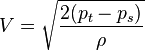


V = \sqrt{\frac{2 (p_t - p_s)}{\rho}} Air is easily compressible, and that makes the formula a little more complicated, since you have to integrate pressure and stagnation values.

Static pressure is a little easier. The air pressure doesn't change at a constant rate as the aircraft flies at a higher altitude, but the curve is relatively constant. Thanks to engineering toolbox we can use:

  p = 101325 (1 - 2.25577 10-5 h)5.25588  

p is air pressure (millibars) and h is height above a fixed point in meters. To get the whole formula, you need to include temperature, and humidity as well, see the wikipedia entry if absolute MSL needs to be measured.   

A small transducer can measure the different pressures, and provide a voltage that the computer can read. Computers are good at math, even complex math, allowing us to have usable information on heads up displays, tapes and other graphical presentations.

The air data computer reads these transducers, and puts the data into a usable format that the FMS can use.

The FMS allows setting marks called bugs on the instruments. If the pilot wants to fly at 250kt indicated airspeed, they may enter a command on the CDU keyboard, it will display on the airspeed indicator. The FMS also allows setting heading bugs, and feeds the flight director when flying on a flight plan.

There are more things in the FMS as well, and as I have time, I'll keep adding to the blog.

Write, and let me know what you think


Sunday, December 1, 2013

FMS FMC and how airplanes know where to go.

Flight Management, how does the airplane know where it is, and where it ought to go. The pilot may want to be in charge, but his job is to manage the systems. There are many systems in an aircraft, and many come together in a single computer called the Flight Management Computer (or Flight Management System). The pilot can use the FMS/FMC on the airplane to help manage these systems.

The heart of the navigation system are the gyroscopes and accelerometers. The gyros are known as the Inertial Reference System (IRS). The IRS will be used to measure changes in flight orientation. The IRS will output heading, attitude and change being imparted. Gyroscopes will measure current conditions, accelerometers will measure the change being imparted on the current conditions.

Gyroscopes are great tools for use in aircraft. The horizon gyroscope will hold true through many oscillations of the aircraft, climbs, turns and dives it will usually show the blue side up. The bank gyro will also handle climbs, turns and dives. The directional gyro will maintain heading for hours.


Accelerometers will measure the forces acting on the aircraft in the various directions. As you were taught in instrument training, or perhaps in private pilot ground school, the seat of your pants isn't accurate at measuring change in coordinated flight. Accelerometers are like the seat of your pants, measuring g forces in three directions (forward/rearward, left/right bank and pitch). They will inform the pilot, or flight management system if the aircraft isn't in coordinated flight, or the increase or decrease of thrust is having and effect.

Integrating the accelerometers and the gyros is how the aircraft can measure where it is relative to where it started. When the aircraft is initialized by the pilot, the current latitude and longitude are entered or received from the GPS system. As the aircraft changes position, the accelerometers will measure the forces acting on the aircraft from the TUG as it pushes the aircraft back from the gate. When the aircraft is in flight, turns can be measured by combining the angle of  bank, and the "vertical" acceleration to measure the horizontal component of lift (HCL), and compare it to centripetal force, to measure the rate of a turn.

A couple posts ago, I was going to talk about Kalman filters. This is where the Kalman filter pays dividends. The Kalman filter will take data that isn't perfect, and make some sense out of it. Sometimes gyros or accelerometers will measure unreasonable values, some large, some small. The Kalman filter will make a best effort to use that information in a way that is reasonable (it may throw the data away, or it may smooth it, such that it looks like a normal reading).

The gyros precess. Since bearings and motors are not perfect, the gyro won't always hold the proper heading for the entire trip. A certified IRS should be accurate to about 650 meters in 1 hour. That means that the aircraft know where it is in the world with a 650meter sphere around it. Most modern aircraft will update the FMS with GPS information, allowing the IRS and the GPS to argue about who is more accurate.

The IRS will output all this information, and the FMS will work together to let the pilot know where the aircraft thinks it is. The FMS will talk to the autopilot, and allow it to make corrections to insure the aircraft gets to it's destination.

The FMS will display what it knows to the pilot through various displays. The primary flight display (PFD) will show the pilot the location it thinks it is, along with what is around the aircraft. The control display unit (CDU) will be the user interface where a pilot can enter flight plan, and other information. The ailerons, rudder and elevator will adjust to make the aircraft head to the programmed direction.


When the aircraft is initialized, the pilot will enter a flight plan. The plan will include airports and other waypoints that the aircraft will be flying to. The FMS will also contain the navigation database. The nav database is where all the waypoints are defined, and any important information about them. The nav database is how the FMS uses the IRS data to know if the aircraft is heading to the proper place in space or not.

 About here is where I need to talk about autopilots, and I am running out of space. I'll talk about autopilots in another post.

Keep me up on your thoughts.

Saturday, November 9, 2013

ACARS - How Texting Works

Okey, texting with airplanes happens all the time. It is part of the whole process. The pilot needs to know stuff, and without tying up the air with a bunch of information the pilot may mis-interpret, or need to read later, the pilot and folks on the ground can communicate with a medium most of use use, in text.

In most aircraft, there is a keyboard and a screen up near both pilots. They have the ability to use this device to send questions to the ground, and the ground has the ability to send messages up to the pilots. Information can include weather, or flight plan changes, gate assignment. Almost anything can be sent to the pilots on the screen.

For the most part, this system works similar to a cell phone. There are ground stations all over the country. These ground stations listen on certain frequencies for a signal on a certain frequency. when these ground stations hear a message, they forward it to the assigned receiver. Each airline has assigned address(es). Delta doesn't want United hearing their messages, as much as Jet Blue doesn't want Southwest hearing their messages. Each aircraft has its' own address as well.

These ground stations are owned by various carriers, similar to cell phones. ARINC and SITA are the two major players in the world. There are some smaller carriers as well, and they are limited to certain regions in the world. The carriers don't typically inter-connect messages. If your airline is using ARINC all messages will be on ARINC equipment once they leave the operations center, until they get to the aircraft.

Different stations in the world use different frequencies so the aircraft don't overcrowd a single ground station. The ground station frequencies are similar to the VHF navigation and communication frequencies already used on the aircraft. Most of the ACARS frequencies are in the 129 to 137MHz range. Each ground station can cover about 200 miles on these frequencies.

If a pilot wants to send a message to a dispatcher in the pilot's airline operation center the pilot would tune to the nearest frequency that is on their chart, and enter the message on the keyboard. The message would get transmitted to the ground station and the carrier would forward the message to the operations center for that airline. When the dispatcher receives the message, they can enter a response. The dispatchers response will be forwarded to the carrier, and based on the last known location, the carrier will forward the message to the nearest ground station. The ground station will send the message to the aircraft.

There are a couple 'if's above. The communications protocol is quite robust, allowing for queued messages to stay queued until the ground station receives the message, and acknowledges it. If a ground station is out of service, or the aircraft is tuned to the wrong frequency, the message will sit on the aircraft, until the situation improves. If nothing else, the messages will be cleared when the aircraft power cycles itself (IE shutdown, and brought back up), no one wants to hear about something that happened yesterday.

There are automatic messages sent over ACARS as well. When the aircraft is first powered up, and the pilot initializes the computers a message will typically be sent to the operation center. This message will go into a database, and allow the airline to look at when things got started, what flight the aircraft is assigned to, and other such information. When the doors are shut, and the brakes are released an out gate time message will be sent to the operations center, and when the aircraft squat switches are showing no weight on wheels, an off ground message time is sent. The time messages that the operations center knows about and uses are called the OOOI (ooey) times, Out gate, Off ground, On ground, and In gate. There are other times, like in range that the gate wants to know about as well.

The pilots will use ACARS for many operational items. If ATC needs to divert and aircraft, the ACARS will be a way the dispatcher and the pilot can determine if there will be operational impacts to ATCs request. Will there be enough fuel to take the new route, or will the new route cause people to be delayed are all considered. If the pilot needs to know about weather ahead, some airlines have the capability to send messages to the aircraft if there are significant changes to the weather.

The ACARS unit will ding when a new message comes in. This ding is handy should the pilot be working a situation in the air, and need to know when the resources on the ground have more information. The ding can be a distraction when the pilots workload is high. Most airlines limit the ding to when the aircraft is above 10000ft. Messages can still happen when the aircraft is below 10000ft, but the ding will not distract them.

Next time you are flying, and you wonder where the pilot got all the up to date information, it probably came over the ARARS unit on the airplane.

Thursday, November 7, 2013

CPDLC - Texting For Pilots

Texting and driving is against the law. Texting and flying, no problem. 

Ok, we aren't talking about your family  asking you to stop by the grocery store pickup some milk on the way home. On most commercial aircraft there is a text based communications system. This is usually the ACARS system, the Aircraft Communications And Reporting System. This display and keyboard is right there usually in the panel, and encouraged to be used in flight.

The ACARS communications start early in the flight. Most airlines participate in the Pre-Departure Clearance (PDC) program where the pilots get the clearance right from the tower on the ACARS screen. The pilot is required to request the clearance before the flight, and the tower will automatically deliver the clearance to the screen.

The ACARS system is also connected to the aircraft maintenance department. The engine and other parts of the aircraft are connected to the computers that are connected to the ACARS system. When the aircraft is in a certain state, an automated message will be delivered to the ground. Engine status will be delivered when the aircraft is in cruise state, and not accelerating (stable cruise report). On ground time will be delivered when the aircraft has main gear down.

Recently, ICAO has standardized the phraseology and the FAA have started delivering ATC messages to the cockpit. The messaging is called Controller Pilot Data Link Communications (CPDLC).  There are some limitations to these messages, generally they will be standard communications. Things like "turn left heading 240 degrees", or "climb and maintain 360". These are normal mundane type messages that the controllers say everyday over and over. The ATC screen has templates of these standard messages, where the controller only need to enter the heading and altitude.

The messages must be acknowledged, or they will be assumed to not be received. The pilot can acknowledge the message or say unable. The controller has the option of using the voice to find out more, or offer a better different message.

There is a huge misnomer, Air Traffic Controllers don't actually control aircraft. The controllers offer suggestions to pilots. Pilots can always do what is needed to operate the aircraft safely, regardless of what the controllers are telling them to do. Normally following the controllers directions will be the safest thing to do, but there is always the option.

The ICAO 4444 document Procedures for Air Navigation Services Air Traffic Management has a chapter on the CPDLC messaging.

    CHAPTER 14. CONTROLLER-PILOT DATA LINK COMMUNICATIONS (CPDLC).


There is another document 9694 Manual of Air Traffic Services Data Link
Applications
that has additional guidance. These CPDLC messages have various levels of urgency, and alerts, and are outlined better in these two manuals.

There is a fear that using CPDLC will prevent pilots from eavesdropping on other pilots. There is a possibility that may occur. CPDLC message are addressed to a specific aircraft, and to a specific ATC center. Normally, when ATC is talking (using voice communications) to the aircraft in an area, they talk on the one frequency that all aircraft can hear. The benefit to that is that if aircraft are near each other, and a command will make another pilot question the intention, the eaves dropping pilot can ask for clarity. Sometimes controllers make mistakes, and pilots can ask. If someone is put on the same altitude and opposite course as another aircraft, the pilot not getting the command make question the controller. With CPDLC addressed messages, other aircraft cannot "hear" those commands.

Mostly the CPDLC systems are in use in the oceanic realm. There is quite a bit of separation going on in that area, and communications has been poor over the ocean. In the past, the oceanic communications, has been over HF voice channel. CPDLC has actually improved the performance of the communication over the ocean.

Long term, some CPDLC messaging will be added to the enroute area. Perhaps to a limited extent, the TRACON will start to get some CPDLC messaging.

Saturday, October 5, 2013

UAT or 1090ES?


If you are considering ADS/B, there is a choice to make. Do you install a Universal Access Transceiver (UAT) or the Mode S transponder that has an extended squitter (1090-ES)? It all depends...

What country are you in? If you aren't in the USA, then the choice is pretty much made. The USA offers the option of a UAT. The rest of the world needs Mode S transponders for ADS/B installations.

If you are in the USA, and you mostly fly above FL180, then the choice is pretty much made again. The FAA doesn't allow aircraft flying above 18,000ft to use the UAT. It just makes sense to get the 1090-ES transponder that will do Mode S if you want take advantage of ADS/B and fly about FL180.

The UAT transmits and receives on 978MHz, the 1090-ES transmits and receives on 1090MHz. The ADS/B system will allow all participating aircraft to see each other. If the two devices work on different frequencies, how does a 1090MHz transceiver see a 978MHz transceiver? The ground stations will repeat the 978MHz messages on 1090MHz, as well as repeat the 1090MHz message on 978MHz. The ground station will also show both messages on the "RADAR" scope, so the air traffic controller knows where everyone is.

The FAA separated the two systems for a couple reasons. The 978MHz devices can handle more data (has more bandwidth), so more aircraft in a concentrated area will work without overloading ground stations or other aircraft. The 1090 Mode S transponders are already on the larger faster aircraft that are flying higher, so the expense should be minimized (I am repeating the FAA here, in reality, most operators will need to replace the transponders they have to get the extended squitter feature).

The UAT's are even more useful, since the FAA will broadcast extra information. The two extra messages that the FAA is broadcasting are the TIS/B and FIS/B. The 1090-ES system will get TIS/B, but not FIS/B.

TIS/B is Traffic Information Service-Broadcast, where non-ADS/B equipped aircraft will show up on the aircraft display, similar to ADS/B equipped aircraft. The ground station will broadcast the position of aircraft that are only visible on RADAR. As a pilot, you will be able to see more of what the controller sees.

FIS/B is Flight Information Service-Broadcast. Flight information includes weather, and aeronautical products. While XM provides some weather, that you must subscribe to, the FIS/B is free to everyone. The XM product may have additional information, or be more timely. The FIS/B data is what the FAA will be looking at, including potentially air traffic control. The aeronautical products appear to be weather like items, such as NOTAMs and SUA status.

Exactly what device to get will depend on the capability of the chosen display. Many of the MFD manufacturers will take either device for input, the displayed information may help make the choice. Some will show the weather RADAR information in great detail, others will show it blocky or not at all. Over the next couple years, the MFDs are sure to get better.

Should you wait, or should you buy today? Today the ADS/B MFD technology is being developed. Over the next 5 years, the technology will surely mature. Having ADS/B in on a tablet computer will allow a pilot to get their feet wet, sooner. By 2020, most aircraft will be required to have ADS/B out, which probably means, unless someone builds an under $1000 solution to ADS/B out only, most aircraft will be equipped with ADS/B in and out.

Can you get rid of your transponder once you have ADS/B? No, the Mode/C component will still be needed for RADAR service and TCAS for non-ADS/B equipped aircraft.

It'll be an interesting couple years going forward. What do you think?


Tuesday, October 1, 2013

DO-178C Reliability


DO-178C quantifies the level of safety needed for an aircraft software system. In an aircraft there are various software systems. Some systems are benign, others are safety critical. Something like a reading light in a passenger compartment would be benign system, if a failure were to occur, the safety of flight is not compromised (unless the passenger throws a tantrum!). In a fly by wire aircraft the control system is generally considered critical to flight.

DO-178C is a standard maintained by the RTCA. The RTCA is a group of aviation professionals that manage standards. It provides a place for manufacturers, user and regulators to come together and provide a consensus of regulations and guidance to managing the technology used in aviation. DO-178C is the guidance the FAA (and other regulation bodies) use to insure avionics and other software systems are certified to the proper level.

DO-178C enhances DO-178B. DO-178C standard was available starting Jan 2012, and was used to update the FAA AC 20-115C during the summer of 2013. There are companion documents related to software, tools, formal methods and testing.

There are 5 safety or Design Assurance Levels (DAL) for DO-178C.
  1. Catastrophic - Failure may cause multiple fatalities, usually with loss of the airplane. (level A)
  2. Hazardous - Failure has a large negative impact on safety or performance, or reduces the ability of the crew to operate the aircraft due to physical distress or a higher workload, or causes serious or fatal injuries among the passengers.  (level B)
  3. Major - Failure significantly reduces the safety margin or significantly increases crew workload. May result in passenger discomfort (or even minor injuries).  (level C)
  4. Minor - Failure slightly reduces the safety margin or slightly increases crew workload. Examples might include causing passenger inconvenience or a routine flight plan change.  (level D)
  5. No Effect - Failure has no impact on safety, aircraft operation, or crew workload.  (level E)

Like any software project safety, security and quality start with planning. It isn't very easy to add security to an existing product, likewise it may not be easy to add safety and redundancy to an existing product.

DO-178 requires documentation. Items such as the Software Requirements Document (SRD) and the Software Design Description (SDD) are a good idea for all software projects they are required for DO-178 certification. Additional documents include Software Verification Cases and Procedures (SVCP) outlines how the software will be tested, and Software Verification Results (SVP) kind of proves that the SVCP was actually done, and the items passed or not.

The typical deliverables for a DO-178 project will include the SRD, SDD, the executables, the SVCP and the SVP. Additionally there may be code coverage test results to insure the test results hits all good and bad situations. If the software product is an upgrade to an existing package, there may be other documents that include Software Configuration Index (SCI) like the source code control system documentation, and the Software life cycle Environment Configuration Index (SECI) to outline the development and improvement process.

Typically a Designated Engineering Representative (DER) will review the deliverable to insure the system meets the level of certification desired. The DER may work for the company developing the product, or be an external consultant.

There are various tools the developers and the testers can use to insure the certification process was followed. Starting with the documentation there are templates.Web based compliance verification tools are available. DO-178 software test suites are also used.

Some vendors will suggest that a level A certification is something to shoot for. Actually, for any system, the lowest possible level should be what the designers should seek. In an ideal situation, any failure should be an inconvenience, not an emergency. If the engines are running, and the flight controls work the aircraft can be flown to a suitable facility where repairs can be made.  

DO-178C is a robust standard that can apply to all software development. DO-178C is required for aviation software systems, and provides customers with piece of mind with regard to systems on the aircraft.

Saturday, September 28, 2013

Here We Go Again


We get to get the threats of the "sequestration" again this fall. Of course we knew about it for most of the last couple years, and who has done anything about it? How about that, the only one who could do something, is congress, the same ones who chose to ignore the trouble.

Congress will play the same game of chicken again this weekend. Nothing new there.  Something will be the pawn, this time it is Obamacare. Fine, whatever, I really don't think we need congress messing with health insurance anyway, I can't see how they can make it better. (this conversation could get recursive about here, so I won't get into congress and health care).

The trouble is, the game of chicken costs everyone more money! Obamacare is in progress, and states have put money into making it work. The money is in the federal budget already, and could be funded. If congress tries to unwind Obamacare, well there will be money wasted by the states, and the fedral government that are working toward the Oct. 1 deadline. Corporations have their HR software ready, the rules were set over a year ago.

So they decide to boot the government out on Oct 1. Well, those government employees just go home, and watch daytime TV and don't get paychecks. Hmmm... they don't buy cars, and limit grocery purchases, and that ripples down to the Best Buy store, and the stock boys at the Albertson's. Yes the whole mess puts a strain on everyone, depending on how long things go on.

Lets see, air traffic control is in play again. Will congress like having their flights delayed? Maybe once, or maybe they have things rigged to not be personally affected this time. If they are delayed, you can bet congress will make a strong effort to adjust budgets to make that part less painful.

How is traffic affected by controllers?

As I wrote in my April Sequestration post, controllers are certified to work a limited section of airspace. If all the people scheduled to work a day can't cover a sector, then planes can't fly in that sector. There are also rules about how long a controller can work a sector without a break (bathroom and lunch breaks are not optional!).

Airspace in IFR conditions is positive control, or only one aircraft can be in a part of airspace until it is known where that aircraft is. I've flown IFR to Livingston Montana in a small airplane before. Livingston is in a valley, and unless you are over 12000ft up, there is no RADAR coverage, and there is no tower at the airport. Once I left Billings MT RADAR area, I was cleared for the approach into Livingston. That meant the controller gave me all that airspace, until I told her that I was on the ground, or back into some other controlled airspace. The controller had to give me exclusive access to that airspace, since she couldn't see me, and she wouldn't know where I would be relative to another aircraft.

If towers are closed the enroute controllers will give the aircraft the airspace around the airport, starting sometimes over 50 miles out. That means only one aircraft can be in that 50 mile area until it is on the ground, or reports that it is going somewhere else. With the tower open, the spacing can be 5 miles between aircraft. With the tower closed it maybe 50 miles of spacing. You can get 10 aircraft on approach with the tower open, and only 1 with the tower closed. Things slow down really fast like that.

Airplanes don't care if the towers are contract or FAA run. If there is proper staffing, then the pilot can fly closer to other aircraft. The aircraft won't have to hold or divert if there are enough people at the tower watching aircraft. There are towers that handle very little traffic, and the staffing could be reduced, and the FAA has tried, but usually some congress person has a special interest in that tower, and it stays open for many hours with few operations.

Again, as flights get late, the second shift or the midnight shift get to work overtime. Congress insures the money saving route actually costs more. If they would just do it right, and leave it alone, they could save real money. You and I have to live within our budget, and changes may cost us money. Congress ignores that whole thought, and let money get spent, knowing that in a year or two they will have to deal with a situation. Waiting until the weekend before will insure things will go bad.

We need a smaller government,  and we could start the cutting with congress.

P.S. Congress will continue to get paid during the shutdown. It is also likely that once the budget is passed, and funding is restored, all the government employees will get retroactive pay.